
A practical method to map buyers, distributors, partners and regulators, prioritise them and prepare the right meetings
Companies entering a new market in Africa or the Middle East often spend months on market sizing, pricing and regulation, then discover that the real obstacle is not the market itself but access to the people who shape it: the distributor who controls a key channel, the procurement head of a major buyer, the office that must register a product, the industry association whose opinion carries weight.
Stakeholder mapping is the discipline of identifying these actors early, understanding what they want and how they relate to each other, and deciding whom to engage first. Done well, it shortens the path to the first useful meetings and reduces costly missteps. This article sets out a practical method, focused on business decisions.
Why stakeholder mapping matters before market entry
In many markets of the region, business moves through relationships. Formal information is available, but it rarely tells you who actually decides, who influences the decision and who can slow it down. A clear map helps you:
- Focus limited management time on the few actors who really shape your entry.
- Identify potential partners, distributors and early customers faster.
- Anticipate administrative steps and the right contacts for each of them.
- Understand how competitors are positioned and where the gaps are.
- Prepare meetings and introductions with a clear purpose.
Step 1: Define your objectives
A stakeholder map is only useful if it answers a business question. “Who matters in this market?” is too broad. “Who decides on listing a new food brand in modern retail in the UAE?” or “Who influences equipment purchases for private clinics in Casablanca?” is actionable. Start by writing down two or three entry objectives: finding a distributor, securing a pilot customer, obtaining a product registration, setting up a local partnership. Each objective will produce a different map.
Step 2: List stakeholders systematically
Next, build a long list. Working by category helps avoid blind spots:
- Customers and buyers: key accounts, procurement teams, end users.
- Channel players: importers, distributors, wholesalers, retailers, e-commerce platforms.
- Partners and suppliers: local manufacturers, logistics providers, service companies.
- Administrative bodies: licensing, standards, registration and customs offices.
- Influencers: industry associations, chambers of commerce, sector experts, specialised media.
- Competitors and their main partners.
For each entry, record the organisation, the relevant role or function, and why it matters for your objective. At this stage, roles count more than names.
Step 3: Prioritise with an influence/interest grid
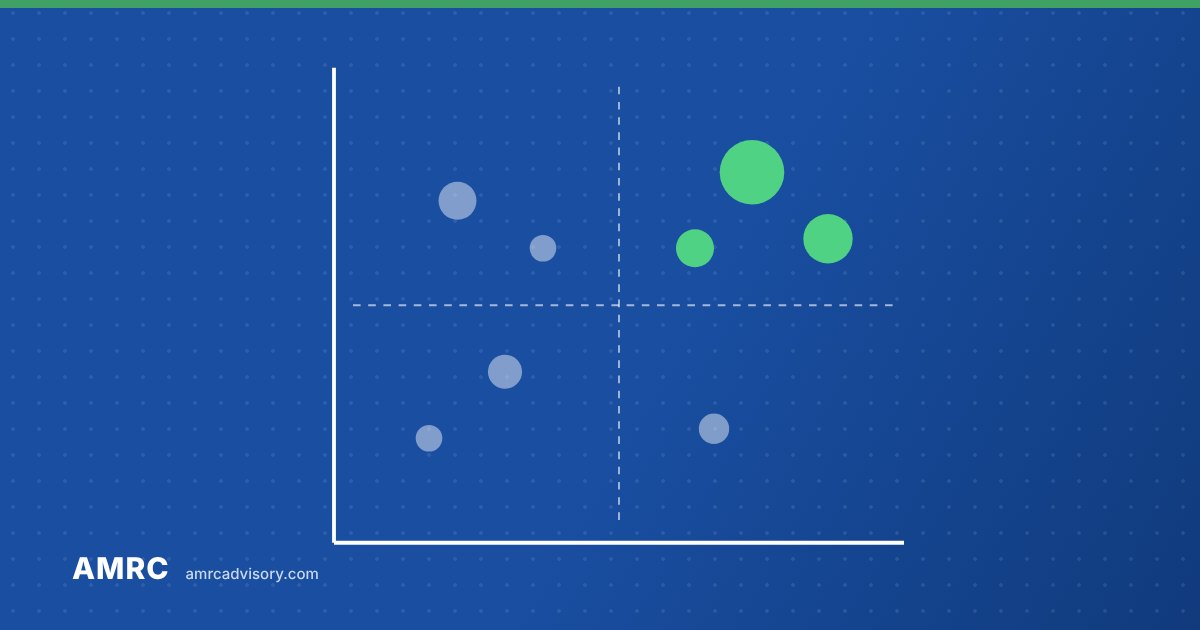
The classic tool is a two-axis grid. One axis measures influence: the ability to affect your entry, positively or negatively. The other measures interest: how much the stakeholder is concerned by your arrival, as an opportunity or as a threat.
- High influence, high interest: manage closely. These are your priority meetings.
- High influence, low interest: keep satisfied, with a short and clear value proposition.
- Low influence, high interest: keep informed. They can become allies or sources of insight.
- Low influence, low interest: monitor with minimal effort.
Where useful, add a third dimension, the stakeholder’s likely attitude towards you (supportive, neutral or reserved), and draw the links between actors: who works with whom, and who listens to whom.
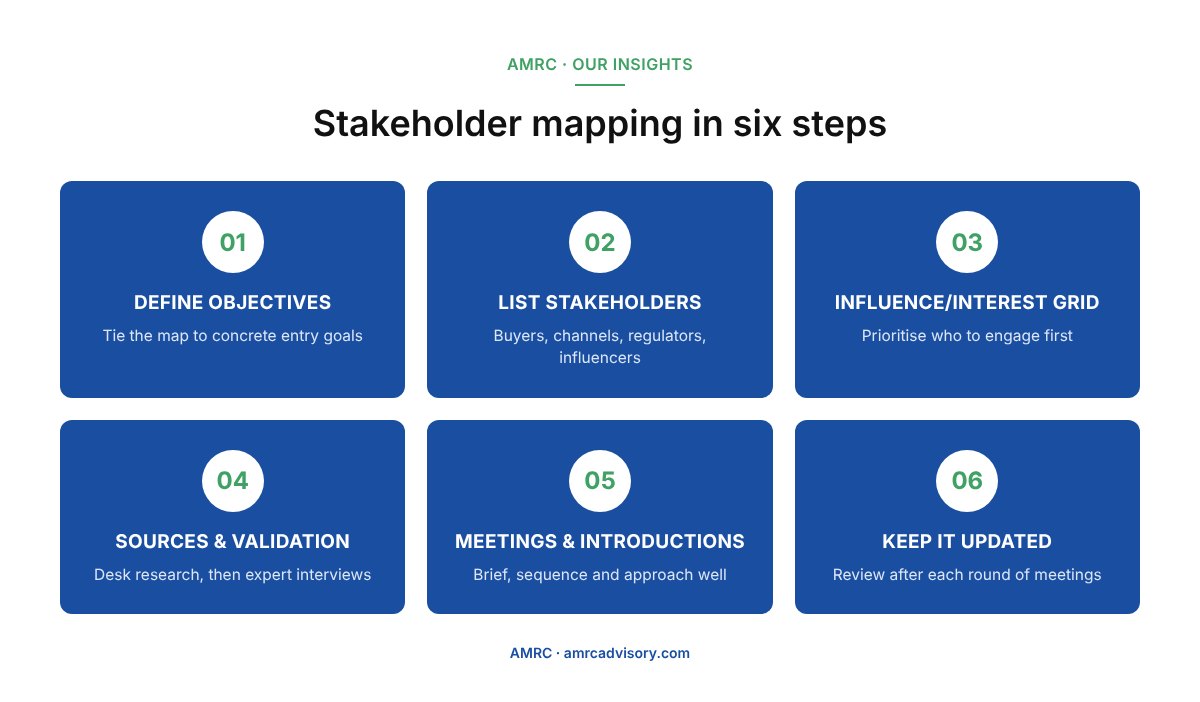
Step 4: Combine sources and validate through interviews
Desk research
Company websites, published reports, trade registers, official publications, trade fair exhibitor lists, association directories, business press and professional networks provide a first layer. They are useful to understand structure, less so to measure real influence.
Field knowledge
The real picture comes from people who know the market from the inside: former executives, distributors, sector experts and consultants. Short, well-prepared conversations quickly reveal who actually decides and how.
Validation interviews
A desk-based map is a hypothesis. Validation interviews test it. Depending on the sector, a limited number of in-depth interviews, often somewhere between ten and twenty-five, is usually enough to confirm key players, correct assumptions and uncover actors nobody had listed. Ask open questions: how decisions are made in practice, who must be convinced, what has worked or failed for other entrants. Cross-check every important statement with at least two sources.
A stakeholder map is not a list of names. It is the answer to one question: whose decision will make or break our entry?
Step 5: Turn the map into meetings and introductions
The value of the map lies in action. For each priority stakeholder, prepare a one-page brief: their likely interests, what you can offer them, the questions to ask and the best route of approach. Introductions through a trusted intermediary generally work better than cold outreach. Sequence the meetings carefully: meeting an established distributor or an industry association before a large buyer can give you credibility and useful feedback on your offer.
Step 6: Keep the map up to date
People change jobs, companies reorganise and rules evolve. Treat the map as a living document, reviewed after each round of meetings and at key milestones. A simple shared table or CRM view with an owner, a status and a next step for each stakeholder is usually enough.
Ethics and discretion
Stakeholder mapping must remain a professional and transparent exercise. Use public and legitimately obtained information, respect data protection rules when storing personal data, and be honest about who you are and why you are asking when you conduct interviews. Never offer anything in exchange for access or information, and avoid collecting personal details that have no business relevance. Discretion protects both your strategy and the people who share their knowledge with you.
Common mistakes to avoid
- Starting with a list of names before defining the business objective.
- Confusing visibility with influence: the most quoted player is not always the decision-maker.
- Relying only on desk research without field validation.
- Focusing on top executives and overlooking channel players and influencers.
- Building the map once and never updating it.
How AMRC can help
AMRC supports companies entering markets in North Africa, the Sahel, West Africa and the Gulf with market entry studies, desk research and expert interviews. We build stakeholder maps around your objectives, validate them in the field in English, French or Arabic, and help you prepare focused meetings with the players that matter, with discretion and professional standards.
Key takeaways
- Start from two or three concrete entry objectives, not from a list of names.
- List stakeholders by category to avoid blind spots, including channels and influencers.
- Prioritise with an influence/interest grid and map the links between actors.
- Validate the desk-based map through well-prepared expert interviews.
- Use the map to brief and sequence meetings, and keep it updated with full discretion.
Frequently asked questions
How long does a stakeholder mapping exercise take?
It depends on the scope. As an indication, a focused map for one market and one or two objectives often takes a few weeks, including desk research, validation interviews and a final review with the client.
What is the difference between a market study and stakeholder mapping?
A market study answers questions about demand, competition, prices and channels. Stakeholder mapping answers who decides, who influences and how to reach them. The two are complementary and are often combined in a market entry project.
Is stakeholder mapping useful for smaller companies?
Yes. Smaller companies have even less time and budget to spend on the wrong meetings. A light, focused map helps them concentrate on the few partners and buyers that can make their entry work.
How is confidentiality handled during interviews?
Interviewers present themselves and the purpose of the study honestly, and sources are not named without their consent. In the early stages, the client’s name can remain confidential, which is a common practice in market entry research.
Preparing to enter a new market?
Tell us about your objectives and we will propose a stakeholder mapping approach, timeline and budget.
