
CAWI, CATI, CAPI or a mix: how coverage, cost, speed, sensitivity, literacy and connectivity should shape your choice
Every survey in Africa starts with the same practical question: how will we actually reach respondents? Online panels promise speed and low cost. Phone interviews offer a middle ground. Face-to-face interviews on tablets remain the reference for many studies, but they take more time and budget.
There is no universally best mode. Each one reaches a different slice of the population and produces different types of bias. The right choice depends on who you need to hear from, what you are asking and how the results will be used. This article compares the main options and offers a simple decision guide.
The four main options
CAWI: online surveys and panels
Computer-assisted web interviewing covers online panels, survey links shared by email or messaging apps, and social media recruitment. It is fast, relatively inexpensive and well suited to visual material such as concept boards or packaging. Its limit is coverage: online panels in most African markets mainly represent urban, younger, more educated and connected adults.
CATI: telephone interviews
Computer-assisted telephone interviewing relies on random digit dialling, client lists or numbers collected in a previous face-to-face wave. Mobile phone ownership is far wider than internet use in many countries, so CATI reaches beyond online panels. Interviews need to stay short, and some groups remain harder to reach, including people who share a phone or live in areas with weak network coverage.
CAPI: face-to-face interviews
Computer-assisted personal interviewing, with enumerators using tablets or smartphones, offers the widest coverage, including rural areas, low-literacy respondents and people without phones. It supports proper probability sampling, longer questionnaires and product or stimulus exposure. It is also the most demanding in terms of logistics, time and cost.
Mixed modes
Many projects now combine modes: a CAPI baseline followed by CATI follow-ups, an online sample for urban consumers plus face-to-face interviews in secondary cities, or CAPI with a self-completion module for sensitive questions. Mixing modes extends reach and controls cost, but it requires careful design so that results remain comparable.
Six criteria that should drive your choice
- Coverage and representativeness: who is excluded by the mode, and does it matter for your decision?
- Cost: online is usually cheapest per interview, face-to-face most expensive, with distances and dispersion driving the field budget.
- Speed: online and phone studies can close in days; face-to-face fieldwork often takes several weeks once preparation is included.
- Sensitive topics: some respondents answer more honestly without an interviewer, others need a trusted person in front of them.
- Literacy and language: self-completion assumes reading ability in the survey language; interviewer-led modes can switch to local languages.
- Connectivity and power: online and phone modes depend on network quality, data costs and charged devices.
When each mode fits best
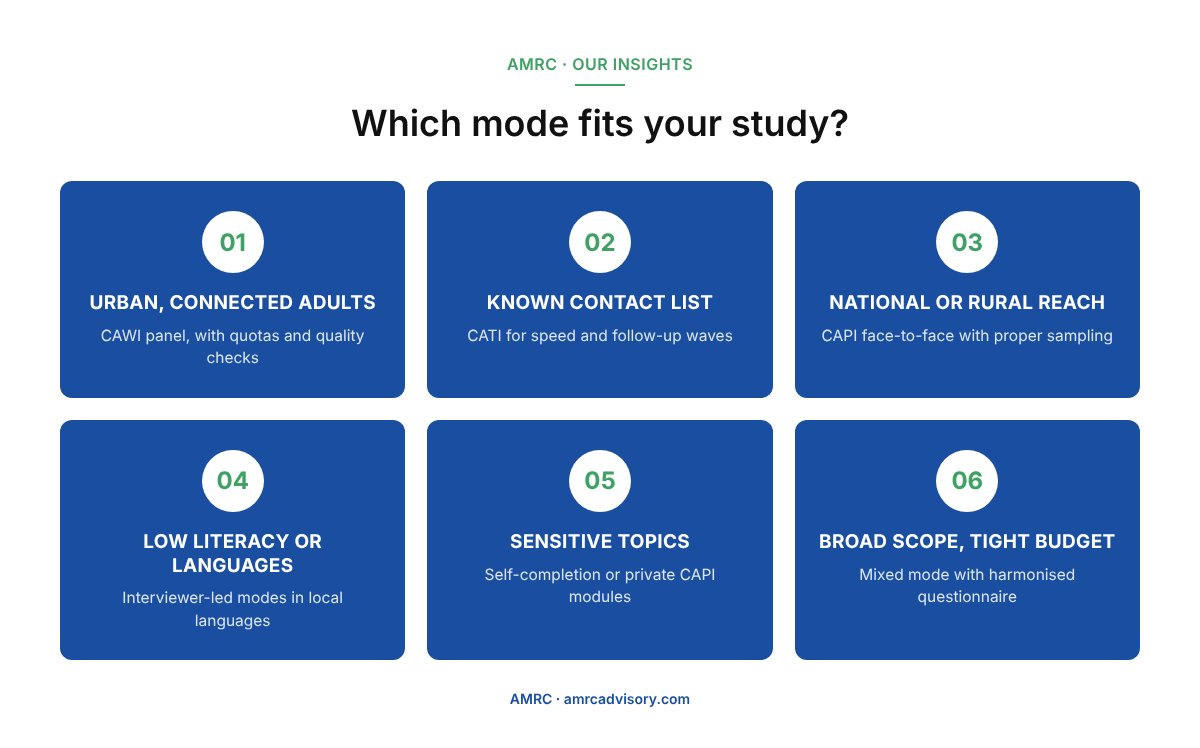
CAWI is a strong option for urban consumer studies, brand tracking among connected audiences, concept and communication tests, and quick pulse surveys. It works best when the target itself is online and the client accepts that results describe that population, not the whole country.
CATI fits customer satisfaction surveys based on client lists, B2B interviews, follow-up waves of panel studies and monitoring surveys where a short questionnaire is enough. It is also a useful fallback when travel is restricted.
CAPI remains the right choice for nationally or regionally representative household surveys, baselines and impact evaluations, rural populations, low-literacy groups, retail and shopper studies at the point of sale, and any study that requires showing or testing products.
The cheapest interview is not the one with the lowest unit price. It is the one that reaches the people your decision actually depends on.
Making mixed modes work
Mode effects are real: the same question can produce different answers online, on the phone and face to face. To keep data comparable, use one master questionnaire, adapt wording only where the mode requires it, keep answer scales identical, and record the mode for every interview. At the analysis stage, compare key indicators across modes and weight the combined sample against reliable population benchmarks where they exist.
Quality control differs by mode
Each mode needs its own quality checks, agreed before fieldwork starts and reported daily.
- Online: attention checks, minimum completion times, removal of straight-liners and duplicate devices or IP addresses.
- Phone: call recordings with consent, supervisor listening, and monitoring of call outcomes and refusal rates.
- Face-to-face: GPS and timestamps, audio audits, back-checks on a share of respondents and daily dashboards.
- All modes: a pilot in real conditions, clear replacement rules and a documented field report at the end.
Sensitive subjects deserve a specific plan whatever the mode: neutral wording, a private setting for the interview, the option to skip questions and, where relevant, a self-completion module on the tablet that the respondent fills in alone.
Common mistakes to avoid
- Presenting online panel results as nationally representative.
- Choosing the mode on cost alone, before defining the target population.
- Running a long questionnaire by phone and accepting high drop-off rates.
- Assuming respondents can read and complete a survey in French or English.
- Combining modes without recording the mode or checking for differences in results.
- Neglecting quality checks online, where speeders and duplicate respondents are common.
How AMRC can help
AMRC designs and runs quantitative data collection across North Africa, the Sahel, West Africa and the Middle East, using face-to-face, telephone, online and mixed-mode approaches. As a subcontractor, local partner or white-label team, we help research companies, consulting firms and development organisations choose the right mode, adapt tools to local languages and deliver clean, documented datasets with daily quality control.
Key takeaways
- Start from the target population, then choose the mode that can reach it.
- Online panels are fast and affordable but mostly cover urban, connected adults.
- Phone surveys extend reach but require short questionnaires.
- Face-to-face CAPI remains the reference for representative and rural studies.
- Mixed modes work when the questionnaire is harmonised and mode effects are checked.
Frequently asked questions
Are online panels representative in Africa?
Generally not of the whole population. They tend to over-represent urban, younger, more educated and connected adults. They can be representative of that online population, which is often enough for digital, urban or premium product studies.
How long can a phone interview be?
As a rule of thumb, phone interviews work best when kept to roughly 10 to 20 minutes. Longer questionnaires increase break-offs and fatigue, so it is better to split content or move to face-to-face.
Is face-to-face always more reliable?
Not automatically. It offers wider coverage, but quality depends on sampling, enumerator training and supervision. Without GPS checks, back-checks and daily monitoring, face-to-face data can also contain serious errors.
Can we switch modes during a study?
Yes, for example moving follow-ups from face-to-face to phone. Plan it from the start, collect phone numbers with consent during the first wave, keep the questionnaire harmonised and record the mode for every interview.
Not sure which data collection mode fits your study?
Share your objectives and target population, and we will recommend a mode, sample design and budget.
