
Scenarios, shopper profiles, omnichannel journeys and scoring: how to build a mystery shopping programme that drives action in the UAE and the Gulf
Retailers and brands in the UAE and the wider GCC track sales, footfall, basket size and conversion with great precision. These numbers show what happened. They rarely show why. A drop in conversion in one mall store, a rise in app order cancellations, a promotion that fails to lift volumes: sales data flags the symptom, not what customers actually experienced.
Mystery shopping fills that gap. Trained evaluators, acting as ordinary customers, go through a defined purchase journey and report objectively on what they saw, heard and received. Used well, it turns brand standards into observable behaviour and gives managers concrete actions. Here is how to design a programme that works in GCC retail.
What mystery shopping reveals that sales data doesn’t
- Whether staff greet customers, understand their needs and suggest relevant products.
- Whether brand standards on display, cleanliness and presentation are applied.
- Whether shelf prices, promotions and checkout prices match.
- How long customers wait, in store, on chat, on the phone or for delivery.
- How questions, returns and exchange requests are handled.
- Whether the experience is consistent across branches, malls, cities and channels.
Start with scenario design
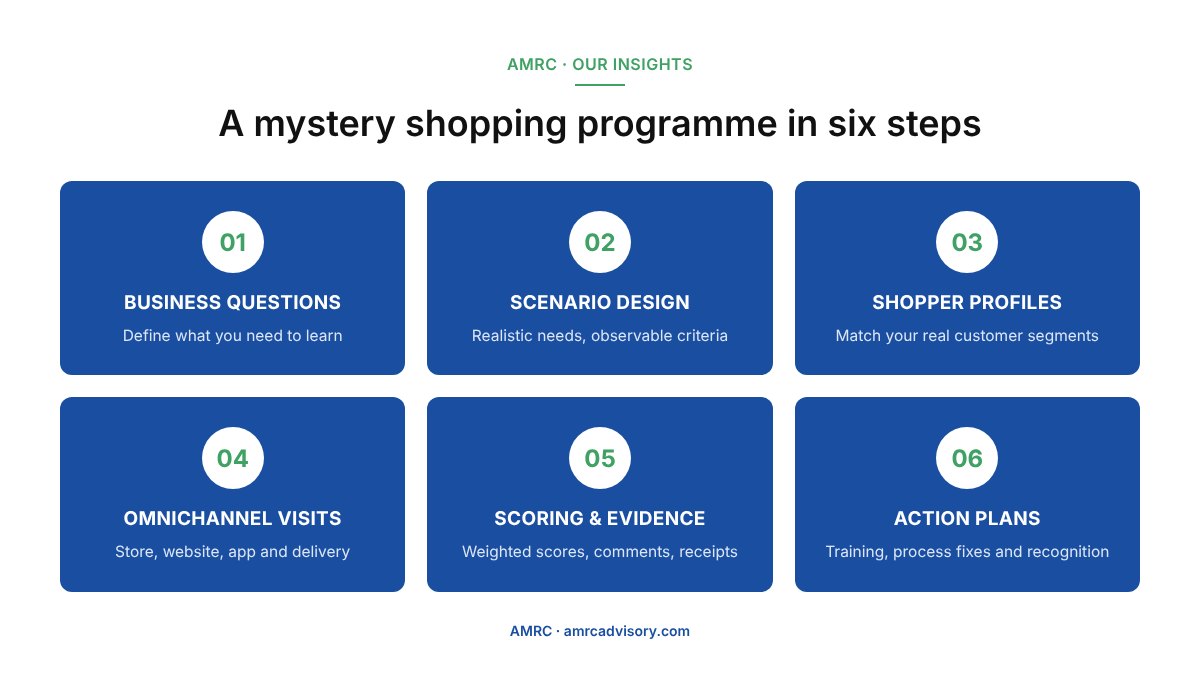
A good programme starts from business questions, not from a generic checklist. What matters most for you: advice quality on premium ranges, product knowledge in electronics, speed of service in quick-service restaurants, personalised recommendations in beauty? Each scenario describes a realistic customer need, the steps the shopper must follow and the observations to record.
- Keep scenarios realistic for the category and the location.
- Mix simple purchases with more demanding situations, such as a detailed product question or a return.
- Use clear, observable criteria (did the staff member offer an alternative: yes or no?) rather than vague impressions.
- Pilot the questionnaire on a few visits before full roll-out.
Shopper profiles that reflect the real customer base
The UAE and other GCC markets serve highly diverse customers: nationals, residents of many nationalities, tourists, different age groups and income levels, and people who prefer to be served in Arabic, English or other languages. Service can vary depending on who walks in. A credible programme recruits shoppers whose profiles match the brand’s actual customer segments, and rotates them so that staff do not recognise evaluators.
Practical details matter too. Some scenarios are best handled by women shoppers, families or specific age groups, and evaluators must be comfortable with local customs and the dress codes expected in malls and stores.
Covering store, online, app and delivery
In the GCC, the customer journey is increasingly omnichannel. A customer may compare prices on an app, order online, collect in store or receive a same-day delivery. Mystery shopping should follow the same path.
In store
Welcome, waiting time, product knowledge, availability, payment, packaging and farewell.
Online and app
Search and navigation, product information, responsiveness of chat or call centre, checkout, payment options and confirmation messages.
Delivery and after-sales
Respect of the delivery slot, condition of the product, courier behaviour, returns process and refund speed.
Brand standards, pricing and promotion checks
For brands selling through third-party retailers, mystery shopping is also a compliance tool. It checks whether planograms, shelf visibility, point-of-sale material and promotional mechanics are applied as agreed, and whether advertised prices and offers are honoured at checkout. During major seasonal sales and festive periods, these checks are particularly useful, because promotions change quickly and execution errors become more likely.
Sales data tells you what customers bought. Mystery shopping tells you what they experienced before deciding.
Frequency, scoring and turning results into action
Frequency depends on objectives. Monthly or quarterly waves suit ongoing service monitoring, while a one-off wave works for a launch, a new store concept or a promotion audit. As an indication, many programmes plan several visits per outlet per wave, at different times and days, so that results reflect more than one staff member or time slot.
Scoring should be weighted towards what really drives the customer experience, and simple enough for store managers to understand. Results become useful when they lead to action:
- Outlet and regional scores shared quickly, with comments and evidence.
- Comparisons over time and between branches, not only absolute scores.
- A root-cause review: is the issue training, staffing, stock or process?
- Recognition for teams that perform well, not only corrective plans.
Ethics and good practice
Mystery shopping evaluates processes and service standards. In line with professional market research codes, good practice includes informing staff in general terms that service evaluations take place, using results to improve processes rather than to target individual employees, and keeping scenarios proportionate so they do not disrupt operations or take excessive staff time. Audio, photo or video recording should only be used where local law allows it and the client has approved it, and all personal data must be protected.
Common mistakes to avoid
- Using a generic checklist that does not reflect your own brand standards.
- Sending shoppers who do not match your real customer profiles.
- Evaluating the store only and ignoring the website, app and delivery.
- Collecting scores without comments or evidence to explain them.
- Using results only to sanction staff instead of improving processes.
How AMRC can help
AMRC designs and runs mystery shopping and customer experience programmes in the UAE and across the Middle East and North Africa, from our office in Dubai and with our field teams in the region. We build scenarios with you, recruit diverse shopper profiles speaking Arabic, English and French, cover store, online, app and delivery journeys, and deliver clear scores, evidence and recommendations. We also work as a white-label field partner for research agencies running programmes in the region.
Key takeaways
- Sales data shows what happened; mystery shopping shows why.
- Design scenarios from your business questions, with observable criteria.
- Recruit shoppers who reflect the diversity of your real GCC customer base.
- Cover the full journey: store, website, app, delivery and after-sales.
- Turn scores into action plans, and run the programme ethically and transparently.
Frequently asked questions
How many visits are needed per outlet?
It depends on the number of outlets, the objectives and the budget. As an indication, several visits per outlet per wave, spread across days and time slots, give a more reliable picture than a single visit. A pilot wave helps fine-tune the plan.
Can mystery shoppers record their visits?
Rules on audio, photo and video recording vary by country and setting. Recording should only be used where local law allows it and the client has approved it. In many programmes, detailed notes completed right after the visit, together with receipts and time stamps, provide sufficient evidence.
How is mystery shopping different from a customer satisfaction survey?
A satisfaction survey captures how customers feel. Mystery shopping measures, against defined standards, what actually happens during a visit or an order. The two are complementary and are often used together.
How quickly are results available?
Individual visit reports can usually be shared within a few days through an online dashboard, with a consolidated report and recommendations at the end of each wave.
Planning a mystery shopping programme in the Gulf?
Share your objectives and outlets with us and we will propose scenarios, a visit plan and a budget.
