
Regional differences, nationals and expatriate residents, gender-appropriate fieldwork and Arabic-first tools: the essentials for reliable consumer research in the Kingdom
Saudi Arabia attracts growing attention from FMCG, retail, food service, beauty, financial services and technology brands. It is the largest consumer market in the GCC, with a young, connected population and a retail landscape that is changing quickly.
For research teams, this creates a real opportunity, but also a trap. Treating the Kingdom as a single market, or copying a fieldwork design from the UAE, often produces data that looks clean but misses key segments. This article summarises what brands and research agencies should plan for before going to field.
1. A young market that is changing fast
The country’s economic transformation has brought new retail formats, entertainment, tourism, delivery apps and digital payments into everyday life. Consumer habits are evolving accordingly, especially among younger adults. The practical consequence is simple: insights that are a few years old may no longer describe today’s shopper. Usage and attitude studies, brand health tracking and category reviews benefit from being refreshed more often than in mature markets.
2. One country, several markets
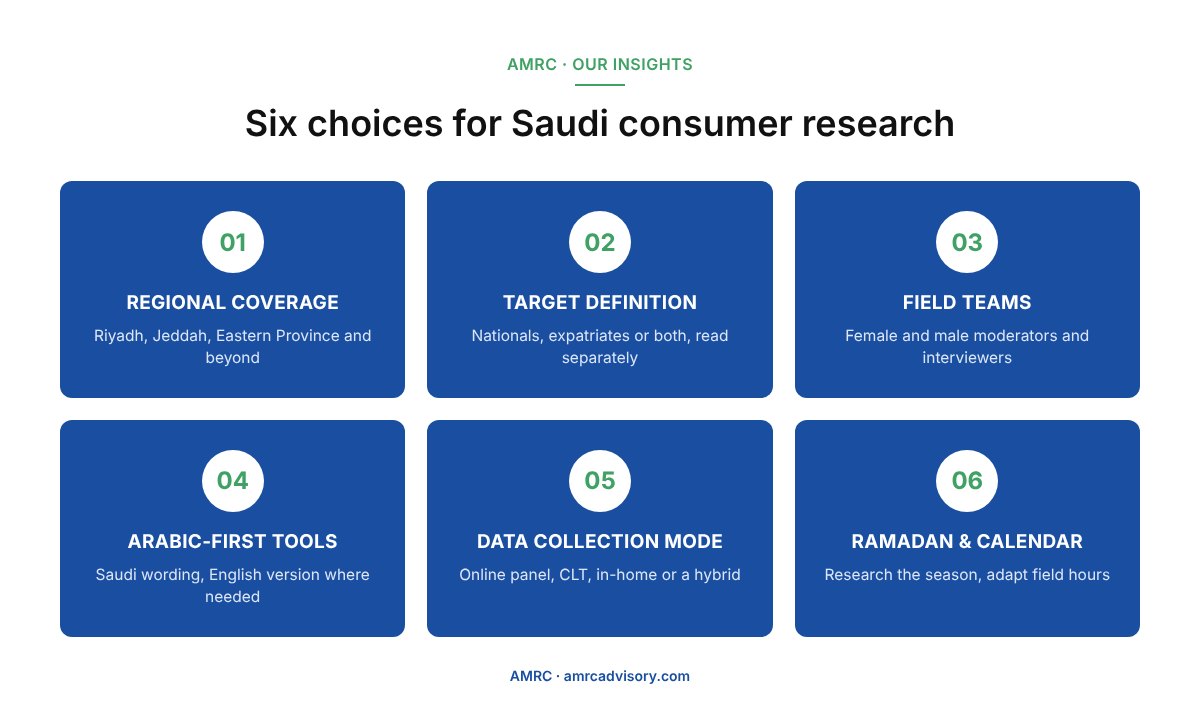
Regional differences in tastes, retail structure, dialect and lifestyle are significant. A national study should cover at least the three main urban poles, and often more:
- Riyadh: the capital and main business hub, home to many corporate headquarters and a fast-growing retail and leisure offer.
- Jeddah and the Western Region: a historic trading city on the Red Sea, with its own consumer culture and retail scene.
- Dammam, Al Khobar and the Eastern Province: an industrial and energy hub with close links to neighbouring Gulf countries.
- Other cities and regions, such as Qassim, Asir, Tabuk or Hail, where household profiles, store formats and media habits can differ from the big three.
Results should be readable by region, which means planning sufficient sub-samples in each area rather than letting the capital dominate the total.
3. Nationals and expatriate residents
Saudi nationals and expatriate residents often differ in household structure, income, shopping channels, brand repertoires and language preferences. Expatriates themselves are far from homogeneous. The first decision is therefore who the study is really about: Saudi consumers, the total resident population, or specific expatriate communities. Quotas should follow that decision, and results should be analysed separately for each group whenever both are included.
4. Gender-appropriate fieldwork and mixed teams
Women are a central target for many categories, from food and personal care to fashion, finance and e-commerce. Reaching them well requires the right field set-up:
- Female moderators for women’s focus groups and in-depth interviews, and male moderators for men’s sessions.
- Mixed teams of interviewers, so that respondents can be interviewed by someone they feel comfortable with.
- Female recruiters to reach women respondents through trusted networks.
- Venues and viewing facilities organised to suit each audience, and separate groups by gender where the topic or target calls for it.
These choices are not a formality. They directly affect participation, openness during discussions and the honesty of answers.
5. Arabic-first tools
Questionnaires and discussion guides should be designed or carefully adapted in Arabic, not translated at the last minute from English. Standard written Arabic works for most surveys, but wording, examples and brand names must sound natural to Saudi respondents, and qualitative moderators should be comfortable with local dialects. An English version remains useful for some expatriate and professional targets. For online surveys, the Arabic version should be tested on mobile for right-to-left display, answer grids and stimulus visibility.
6. Online panels or face-to-face?
Smartphone and internet use are widespread, and online panels are an efficient option for many urban consumer studies, concept screening and trackers. They have limits, though: some groups, such as older respondents, lower-income residents or people in smaller cities, may be harder to reach or less active on panels. Panel quality also varies, so checks on duplicates, speeders and inconsistent answers are essential.
Face-to-face methods remain valuable for product and sensory tests, central location tests in malls or dedicated venues, in-home visits and hard-to-reach targets. Many projects combine both: an online core sample, boosted with face-to-face interviews for under-represented segments.
7. Recruiting B2B respondents
B2B research in Saudi Arabia, with distributors, retailers, procurement managers or senior executives, depends heavily on access and trust. Cold invitations rarely work on their own. Effective recruitment combines professional networks, referrals, sector directories and a credible, well-introduced invitation in Arabic and English. Interviews should be scheduled within the Sunday to Thursday working week, with flexibility for last-minute changes, and senior respondents often prefer short, well-prepared sessions in person or by video call.
Plan fieldwork around Ramadan and the calendar
Ramadan is the most important consumption season of the year in Saudi Arabia. Spending on food and beverages, household products, gifting, apparel and electronics rises, retailers and brands launch their biggest campaigns, and daily routines shift: shopping, media consumption and social gatherings move towards the evening and late at night. The Eid al-Fitr holiday that follows, and Eid al-Adha later in the year, are also major peaks for retail, travel and gifting.
For brands, this makes Ramadan a research topic in its own right, not only a constraint on the field calendar:
- Ramadan usage and shopping studies, to understand how menus, baskets, store choice and online ordering change during the month.
- Concept, pack and advertising tests run two to three months before Ramadan, so that results can still shape the campaign.
- Shopper and in-store research during the month itself, scheduled in the evening when stores are busiest.
- Post-campaign evaluation shortly after Eid, while memories of the communication are still fresh.
Fieldwork during Ramadan is entirely possible, but it needs to be adapted: interviews and focus groups are best scheduled after iftar or in the late evening, sessions should be shorter, and recruitment needs more time. Outside Ramadan, availability also changes with the hottest summer months, school holidays, public holidays and peak travel periods. Fieldwork dates should be agreed early, with a buffer, and tracker waves should not compare a Ramadan period with a non-Ramadan period without adjustment.
The value of a local partner
A field partner with Saudi experience brings recruiters, moderators and interviewers of both genders, venues in several cities, Arabic-first tool adaptation and quality-control routines. The client keeps control of the methodology and analysis, while the partner manages the operational detail that makes or breaks data quality.
Saudi Arabia rewards brands that research it as several markets, with the right teams and the right language from day one.
Common mistakes to avoid
- Sampling only in Riyadh and presenting the results as national.
- Mixing nationals and expatriates in one total without separate reading.
- Running women’s groups or interviews without female moderators and recruiters.
- Translating an English questionnaire word for word instead of adapting it in Arabic.
- Relying only on an online panel for targets it does not reach well.
How AMRC can help
AMRC supports brands, research agencies and consulting firms with consumer and B2B research in Saudi Arabia and across the GCC, as a full-service provider, subcontractor or white-label field team. From our Dubai office, we design Arabic-first tools, recruit consumers and professionals, organise mixed field teams and deliver quality-controlled data and clear insights, in English, French and Arabic.
Key takeaways
- Treat Saudi Arabia as several regional markets, not one.
- Decide early whether the study targets nationals, expatriates or both, and read them separately.
- Use female and male moderators, recruiters and interviewers.
- Design tools in Arabic first and test them on mobile.
- Combine online panels and face-to-face methods to cover the full target.
- Treat Ramadan as a key research season and adapt field hours to it.
Frequently asked questions
Which cities should a national consumer study in Saudi Arabia cover?
At a minimum, Riyadh, Jeddah and the Dammam and Al Khobar area. Depending on the category and the budget, adding one or two secondary cities gives a more complete view of the market.
Can focus groups be mixed-gender?
It depends on the topic and the target. In most consumer projects, separate groups for women and men, each led by a moderator of the same gender, encourage more open discussion and are the safer default.
Is an online panel enough for a representative study?
For connected urban adults, panels can work well. For a broader representation of the population, a hybrid design with face-to-face boosts for under-represented groups is usually more reliable.
Can fieldwork take place during Ramadan?
Yes. Many brands deliberately study consumers during Ramadan because it is the peak consumption season. Interviews and groups are usually scheduled after iftar or in the late evening, sessions are kept shorter and recruitment is planned with extra time. For campaign decisions, concept and advertising tests are best run two to three months before Ramadan.
How long does a consumer study in Saudi Arabia take?
As an indication, an online survey can be fielded in one to three weeks once tools are validated. Multi-city qualitative or face-to-face projects usually need three to six weeks including recruitment, depending on targets and the season.
Planning consumer research in Saudi Arabia?
Tell us about your target and objectives, and we will propose a sampling plan, method and timeline.
