
Who uses your category, how, when and why: what a U&A study answers, how to design it and how to turn its results into brand decisions in North Africa, the Gulf and West Africa
Many brand decisions are taken on assumptions: that young urban consumers drive the category, that price is the main purchase criterion, that a brand is well known because it has been on shelf for years. Sometimes these assumptions are right. Often they are only partly true, and the gap is where competitors gain ground.
A Usage & Attitude (U&A) study replaces assumptions with a structured picture of the category: who the users are, how and when they consume, what they expect and how they see each brand. It is usually the first large study a company commissions when entering a market or rethinking a brand, and the reference that later studies build on.
1. What a U&A study answers
A well-designed U&A answers a set of simple but fundamental questions about a category, whether it is a food product, a personal care item, a telecom service or an insurance product.
- Who uses the category, and who does not? Penetration by age, gender, region, income and household type.
- How is it used? Frequency, quantities, formats, preparation or usage habits.
- When and where? Moments of the day, occasions, at home or out of home, alone or shared.
- Why? Needs, motivations, barriers and the attributes that drive choice.
- Where and how is it bought? Channels, pack sizes, price perceptions, who decides and who buys.
2. The brand funnel: from awareness to loyalty
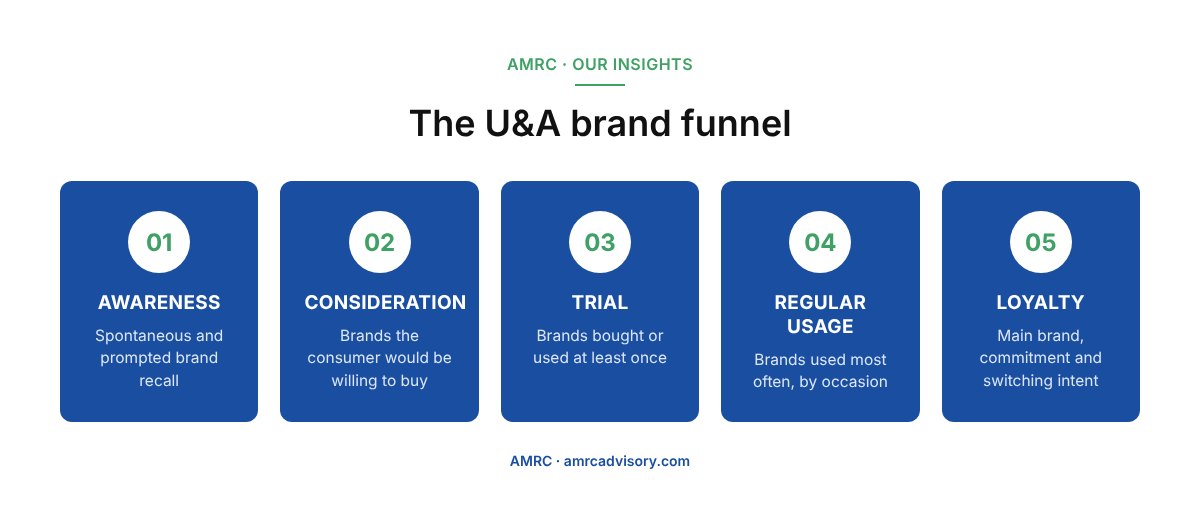
At the core of most U&A studies is the brand funnel. It tracks each brand through successive stages: awareness, consideration, trial, regular usage and loyalty. The value lies less in the absolute figures than in the conversion between stages.
A brand with strong awareness but weak consideration has an image or relevance problem. A brand that is tried but not adopted may have a product, price or availability issue. A brand with high loyalty among a small base may have room to grow through recruitment. Comparing funnels across brands shows where each one leaks, and where the main growth lever lies.
3. Segmentation, needs and occasions
Averages describe nobody. A U&A study becomes truly strategic when it identifies groups of consumers who behave and think differently. Segmentation can be based on demographics, usage intensity, attitudes or needs, and the most useful approaches often combine several of these.
A needs and occasions lens is particularly powerful. The same consumer may choose a different product for a quick breakfast, a family meal or receiving guests. Mapping these occasions, and the needs attached to each one, reveals spaces where a brand can position itself or where an innovation could fit.
4. Structuring the questionnaire and the sample
Questionnaire structure
A typical U&A questionnaire moves from the general to the specific: screening and profile, category usage and habits, purchase behaviour, brand awareness and funnel, brand image, needs and attitudes, then media and information sources. Interview length must stay reasonable, as fatigue quickly degrades answer quality. Translation into the languages actually spoken, such as Arabic and its local dialects, French, English or local languages, should be tested in a pilot.
Sample design
The sample must reflect the target population, not only the easiest-to-reach consumers. This means defining clear quotas by region, urban and rural areas, age, gender and socio-economic level, and boosting small but important groups so they can be analysed. Depending on the category and the number of segments, samples of several hundred to a few thousand interviews are common. In markets where online access is uneven, face-to-face or mixed-mode collection is often needed to avoid a skewed picture.
5. Reading and using the results
A U&A produces a large amount of data. Its value depends on how it is translated into decisions. Strong reporting goes beyond descriptive charts and answers the business questions set at the start.
- Marketing: positioning, target segments, key messages and brand priorities.
- Product and innovation: unmet needs, formats, pack sizes and price points.
- Sales and distribution: priority channels and regions.
- Media: the touchpoints and information sources that reach each segment.
A good U&A study does not tell you everything about your consumers. It tells you which few things matter most for your next decisions.
6. Contexts across North Africa, the Gulf and West Africa
U&A studies are used across FMCG and services in the region, but each context shapes the design. In North Africa, traditional and modern trade coexist, and purchase habits can differ markedly between large cities and smaller towns. In the Gulf, the diversity of nationalities and languages in the population makes careful quota design essential. In West Africa, informal channels, small pack formats and shared household consumption are often central to understanding the category.
7. When to refresh a U&A
A U&A is not a one-off exercise. Many companies refresh it every few years, or sooner when the market changes: a new competitor, a price shift, a change in distribution or a major product launch. Between full waves, a lighter brand tracking study can follow key funnel indicators, using comparable questions so trends remain readable.
Common mistakes to avoid
- Starting with a questionnaire instead of the business decisions it should inform.
- Building a sample that covers only large cities or online users.
- Making the questionnaire so long that answer quality drops.
- Changing key questions between waves, making trends impossible to compare.
- Delivering a thick report with no clear recommendations or priorities.
How AMRC can help
AMRC designs and runs Usage & Attitude studies for FMCG and service brands in North Africa, the Gulf and West Africa: questionnaire design, sample and quotas, face-to-face and mixed-mode fieldwork, analysis, segmentation and actionable reporting, in Arabic, French and English. We also act as a field partner or white-label team for research agencies and consulting firms running U&A studies in the region.
Key takeaways
- A U&A study shows who uses the category, how, when, where and why.
- The brand funnel reveals where each brand loses consumers between awareness and loyalty.
- Segmentation by needs and occasions turns data into positioning and innovation ideas.
- The sample must reflect the real population, beyond large cities and online users.
- Refresh the U&A when the market changes, and track key indicators in between.
Frequently asked questions
What is the difference between a U&A study and brand tracking?
A U&A is a broad, in-depth study of the whole category: users, habits, needs, occasions and brands. Brand tracking is lighter and repeated more often, following a selection of key indicators such as awareness, consideration and usage over time.
How long does a U&A study take?
As an indication, a single-country U&A often takes six to ten weeks from design to final report, depending on sample size, the number of regions and languages, and the depth of analysis required.
Can a U&A study be run online?
In markets with high internet access and well-profiled panels, online collection can work well. Where access is uneven, face-to-face or mixed-mode collection is usually needed so that less connected consumers are represented.
Can one U&A cover several countries?
Yes, with a common core questionnaire adapted to each market’s brands, channels and languages. Results should be compared carefully, focusing on patterns and conversion rates rather than raw levels alone.
Planning a U&A study in your category?
Tell us about your brand, markets and decisions ahead, and we will propose a study design and timeline.
