
Beyond satisfaction scores: how journey mapping, moments of truth, surveys and qualitative research reveal the real experience across branches, call centres, WhatsApp and apps
Most companies already measure customer satisfaction in some form: a post-visit survey, a star rating in the app, an annual study. Yet many are surprised when customers leave, complain on social media or quietly move part of their spending to a competitor, while scores remain stable.
The gap usually comes from what is measured. Satisfaction tells you how customers rate you at a given moment. Customer experience (CX) research looks at what they actually go through: the steps, the waiting, the repeated explanations, the channel switches and the emotions along the way. This article explains how to build that fuller picture.
1. Customer experience is not the same as satisfaction
Satisfaction is an outcome. Experience is the sequence of interactions that produces it. A customer can be satisfied with a friendly branch adviser and still be exhausted by the three visits it took to complete a simple request. If you only measure the final rating, you see the friendly adviser and miss the three visits.
CX research therefore starts from the customer’s objective, such as getting a product delivered, resolving a billing issue or activating a service, and examines everything that happens until that objective is reached, or abandoned.
2. Journey mapping and moments of truth
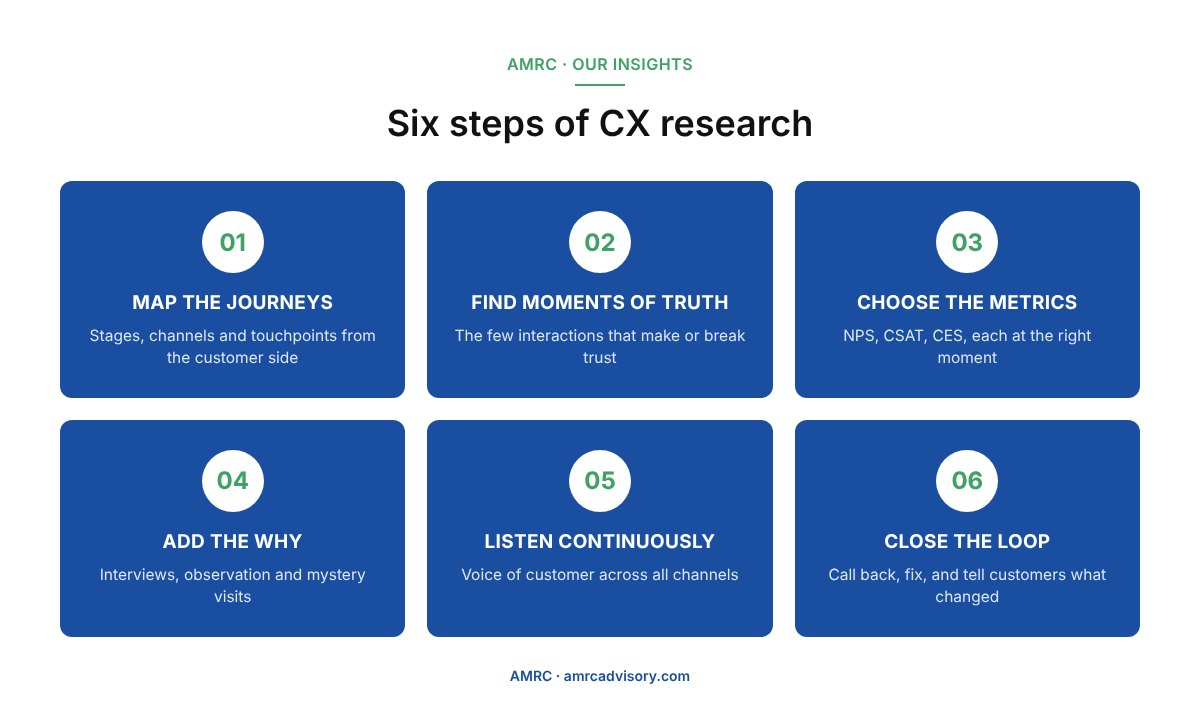
A customer journey map describes, from the customer’s point of view, the stages of a given experience, the channels used at each stage and what the customer thinks and feels. It should be built from research with real customers, not only from internal process charts, which describe how things are supposed to work.
Within each journey, a few interactions carry most of the weight. These moments of truth are where trust is won or lost: the first contact, the moment a problem occurs, the handover between two departments, the first bill. Identifying them helps a company focus its measurement and its improvement budget where it matters most.
3. NPS, CSAT and CES: useful, but limited
Three indicators dominate CX measurement, and each answers a different question.
- Net Promoter Score (NPS): would the customer recommend you? A good relationship indicator, but it says little about what to fix.
- Customer Satisfaction (CSAT): how satisfied was the customer with a specific interaction? Easy to collect, but sensitive to timing and to the mood of the moment.
- Customer Effort Score (CES): how easy was it to get things done? Often the most actionable, because effort points directly to friction in a process.
Their limits are well known. Scores can vary with question wording, scale translation and cultural response styles, which matters when comparing countries or languages. Response rates are often low and skewed towards very happy or very unhappy customers. And a number on its own never explains why. Indicators should be chosen per journey and per moment, with an open question attached, rather than applied everywhere by default.
4. Combining surveys, qualitative research and mystery shopping
No single method captures the whole experience. Strong CX programmes combine several sources:
- Quantitative surveys to measure scores across journeys, segments and channels, and to track them over time.
- In-depth interviews and accompanied journeys to understand expectations, emotions and the reasons behind scores.
- Mystery shopping to check, from the outside, whether promised standards are delivered consistently.
- Operational data, such as waiting times, call volumes and complaint categories, to link perceptions with facts.
The value comes from reading these sources together. When a low effort score, a cluster of complaints and a mystery visit all point to the same step, the priority is clear.
5. Voice of customer programmes and closing the loop
A voice of customer (VoC) programme turns one-off studies into continuous listening. It collects feedback at key moments, centralises comments from surveys, call centres, social media and messaging channels, and routes them to the teams who can act.
Closing the loop is what makes it credible. At the individual level, unhappy customers are contacted, ideally within a short time, to understand and resolve their issue. At the organisational level, recurring problems are assigned an owner, fixed, and the change is communicated. Customers who see that their feedback leads somewhere are more willing to keep giving it.
Measuring experience without acting on it is just a more expensive way of learning what your customers already know.
6. CX in multi-channel contexts across Africa and the Middle East
In many markets of the region, customers move constantly between channels. They may visit a branch or agency, call a hotline, send a WhatsApp message, use a mobile app and ask a relative for advice, all within the same request. Each channel often belongs to a different team, with its own data and its own indicators.
- Map hybrid journeys explicitly, including messaging channels that are often left out of formal measurement.
- Measure continuity: does the customer have to repeat information at each channel switch?
- Cover the languages customers really use, such as Arabic and its local dialects, French, English and, in some markets, local languages.
- Include less connected customers through phone or face-to-face interviews, so the picture is not limited to digital users.
Common mistakes to avoid
- Treating a single satisfaction score as a measure of the whole experience.
- Building journey maps from internal processes without talking to customers.
- Applying NPS everywhere without asking what decision it will support.
- Measuring each channel separately and missing the friction between them.
- Collecting feedback without a clear process to call customers back and fix root causes.
How AMRC can help
AMRC designs and runs customer experience research across North Africa, the Gulf and West Africa: journey mapping, CX surveys, in-depth interviews, mystery shopping and support for voice of customer programmes, in Arabic, French and English. We work directly for brands and service providers, and as a field and research partner for consulting firms and research agencies.
Key takeaways
- Satisfaction is an outcome; customer experience is the sequence of interactions behind it.
- Build journey maps with real customers and focus on the moments of truth.
- Use NPS, CSAT and CES where they fit, always with an open question explaining the score.
- Combine surveys, qualitative research, mystery shopping and operational data.
- Close the loop with customers and fix root causes across channels.
Frequently asked questions
Which CX metric should we choose: NPS, CSAT or CES?
It depends on the decision you need to make. NPS is useful for tracking the overall relationship, CSAT for rating specific interactions and CES for spotting friction in processes. Many programmes use NPS at relationship level and CES or CSAT at key touchpoints.
How many customers should be interviewed for journey mapping?
Journey mapping relies mainly on qualitative research. As an indication, a few dozen in-depth interviews or accompanied journeys per main segment are often enough to identify stages and pain points, which can then be quantified through a survey.
Can CX scores be compared across countries?
With caution. Translation, scale interpretation and cultural response styles affect scores. It is safer to compare trends within each country and to look at the drivers behind scores rather than ranking countries on raw numbers.
Should WhatsApp and social media be part of CX measurement?
Yes, when customers use them to contact you. These channels often carry a large share of everyday requests, and leaving them out gives an incomplete and sometimes misleading picture of the experience.
Want to see your service through your customers’ eyes?
Tell us which journeys and channels matter most, and we will propose a CX research plan.
