

From account opening to cross-channel journeys, the CX dimensions that tell a bank where its digital offer wins, and where customers quietly give up
Moroccan banks have invested heavily in mobile apps, online onboarding and digital services over recent years. Customers can now check balances, transfer money and pay bills from their phones, and new digital-first offers target young and connected users.
Yet having a good app is not the same as delivering a good digital experience. Many customers still go to the branch to finish a process started online, call the bank because a feature is unclear, or keep their main relationship with a competitor. To understand why, banks need to measure the experience from the customer’s side, journey by journey and segment by segment.
1. The account opening journey
Onboarding is the first real test of a digital promise. It is also where many prospects drop out without the bank ever knowing why.
- How many steps and screens are needed, and which documents are requested.
- Where prospects hesitate or abandon: identity verification, selfie, signature, document upload.
- Whether a branch visit is still required, and how clearly this is explained.
- How long it takes from application to a usable account and card.
2. Mobile app usability
Usability is about whether real customers can complete key tasks without help: making a transfer, adding a beneficiary, paying a bill, blocking a card, downloading a statement. Testing should also cover language options in Arabic and French, readability for older users and performance on mid-range phones and unstable connections.
Usability findings are most useful when they are tied to specific screens and wording. A label that seems obvious to the product team, or a confirmation step that appears too late, can be enough to make a customer abandon a transfer and call the bank instead.
3. Trust and security perception
In digital banking, perceived security matters as much as actual security. Customers who fear fraud, distrust SMS codes or do not understand why a transaction was blocked may simply stop using the app for anything beyond checking their balance. Measuring trust means asking how safe people feel, which features reassure them and which messages create anxiety.
Qualitative interviews are particularly helpful here. They reveal the stories customers have heard from relatives or on social media, the habits they have developed to feel safe, and the reasons why some prefer to keep large operations for the branch.
4. Customer support
When something goes wrong, the quality of support defines the relationship. Banks should assess every contact point: in-app chat, chatbot, call centre, social media and branch advisers. Useful indicators include ease of reaching a person, clarity of answers, first-contact resolution and the tone used with customers, in both Darija or Arabic and French.
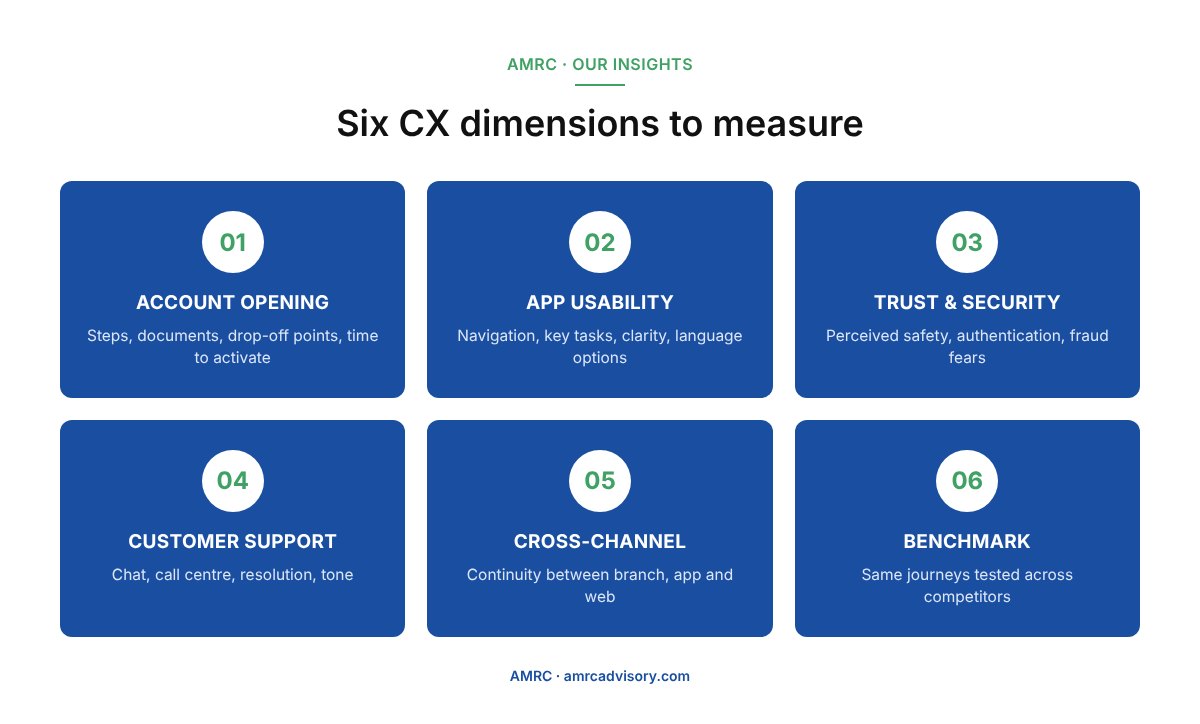
5. The cross-channel experience: branch and app
Most Moroccan customers still combine channels. A loan request may start in the app, continue by phone and end in a branch. The key question is whether the information follows the customer, or whether they must repeat everything at each step. Mapping these hybrid journeys often reveals the biggest sources of frustration, and the quickest wins.
Branch staff are part of the digital experience too. When advisers know the app well, help customers activate it and resolve issues on the spot, adoption tends to follow. When they are unfamiliar with it, customers receive mixed signals.
Customers do not compare your app with your previous version. They compare it with the best digital experience they had last week, in banking or elsewhere.
6. Benchmarking, mystery shopping and UX testing
Internal data shows what customers do inside your own channels. It says little about how you compare. Three complementary methods fill that gap.
Competitive benchmarking
The same journeys, such as account opening, transfers or card blocking, are tested across several banks with a common grid, to see where each one leads or lags.
Mystery shopping
Trained shoppers with defined profiles contact branches, call centres and chat channels, or attempt to open an account, and report on the experience step by step.
UX testing
Customers perform real tasks on the app while observed, in person or remotely, and comment aloud. This shows exactly where interfaces confuse people.
7. Segments and CX indexes
Averages hide very different experiences. A useful CX programme reads results by segment:
- Youth and students: high expectations of speed, design and instant features.
- SMEs and self-employed: multi-user access, payments, cash management and responsive advisers.
- Moroccans living abroad (MRE): remote onboarding, transfers, account management from abroad and support across time zones.
- Mass market: simplicity, clear fees, reassurance and assistance for less digital users.
A CX index brings these measures together into a small set of tracked scores, combining satisfaction, effort, trust and recommendation. Repeated over time and compared with competitors, it gives management a clear view of progress.
Common mistakes to avoid
- Relying only on app-store ratings and internal analytics.
- Testing journeys with staff instead of real customers.
- Measuring digital channels separately from branches and call centres.
- Reporting a single average score without reading it by segment.
- Running a one-off study with no follow-up wave to track progress.
How AMRC can help
AMRC helps banks and fintechs in Morocco measure and improve their digital customer experience. We design and run journey mapping, UX testing with real customers, mystery shopping across channels, competitive benchmarking and CX tracking, covering youth, SMEs, MRE and mass-market segments, in Arabic, Darija and French. We also work as a field and research partner for consulting firms and research agencies serving the sector.
Key takeaways
- Measure onboarding step by step to find where prospects drop out.
- Test app usability and perceived security with real customers, not staff.
- Assess support and cross-channel continuity between app, phone and branch.
- Benchmark the same journeys against competitors using mystery shopping and UX testing.
- Read results by segment and track them over time with a CX index.
Frequently asked questions
What is the difference between UX testing and mystery shopping?
UX testing observes real customers performing tasks on an app or website to identify usability problems. Mystery shopping uses trained shoppers who follow a scenario across channels, such as branch, call centre or chat, and assess service quality against a grid.
Can a bank benchmark competitors’ apps legally?
Yes, when the benchmark relies on publicly available journeys, accounts opened by shoppers under normal conditions and assessments of the visible experience. No confidential data from competitors is used.
How often should a CX index be measured?
Many banks track key journeys every quarter or every six months, with a deeper annual study. The right rhythm depends on how often the app and processes change.
Why include MRE in a digital banking study?
Moroccans living abroad use banking services remotely by definition. Their experience of onboarding, transfers and support from abroad is a strong test of how well a bank’s digital channels really work.
Want to know how your digital experience really compares?
Tell us which journeys and segments matter most, and we will propose a CX measurement plan.
