
Sampling, indicators, comparability and data management: how to design a baseline that still holds up at midline and endline
Almost every development programme financed by the World Bank, UN agencies, the African Development Bank or bilateral donors includes a baseline survey in its monitoring and evaluation plan. It is often one of the first deliverables after inception, and it frequently happens under time pressure while the programme team is still setting up.
Yet the baseline is the reference point against which every later result will be judged. Mistakes made at this stage are rarely fixable at midline or endline. This article sets out what M&E teams, development organisations and consulting firms responding to terms of reference should get right from day one.
1. Start from the results framework, not from a generic questionnaire
The first task is to map each indicator in the programme’s results framework or logframe to a precise measurement. Many indicators look clear on paper but leave room for interpretation: what counts as a household enterprise, an improved practice or access to a service?
- Write an operational definition for every indicator, including the unit, reference period and calculation.
- Identify which indicators need survey data and which can come from administrative or programme records.
- Check whether the donor uses standard indicator definitions and align with them.
- Remove questions that do not feed an indicator or a clearly stated analytical need.
2. Design the sample for the comparisons you will need later
A baseline sample should be designed with the final analysis in mind. If the evaluation will compare beneficiaries with a comparison group, or regions with each other, the sample must be large enough to detect a realistic change between rounds.
Key sampling decisions
- Power calculations based on the expected effect size, intra-cluster correlation and attrition.
- Stratification by zone, gender or type of beneficiary when results must be reported separately.
- Clear rules for replacing households or businesses that cannot be found or refuse.
- A sampling frame that is documented, so that the same population can be reached again.
3. Build comparability with midline and endline into the design
Comparability is the main reason a baseline exists. The same questions, wording, answer options, reference periods and calculation rules should be used in every round. If a question must change, the change should be documented and, where possible, both versions asked once to allow a bridge.
Seasonality also matters. Income, food security or labour indicators can vary strongly across the year, so later rounds should ideally take place in the same period as the baseline.
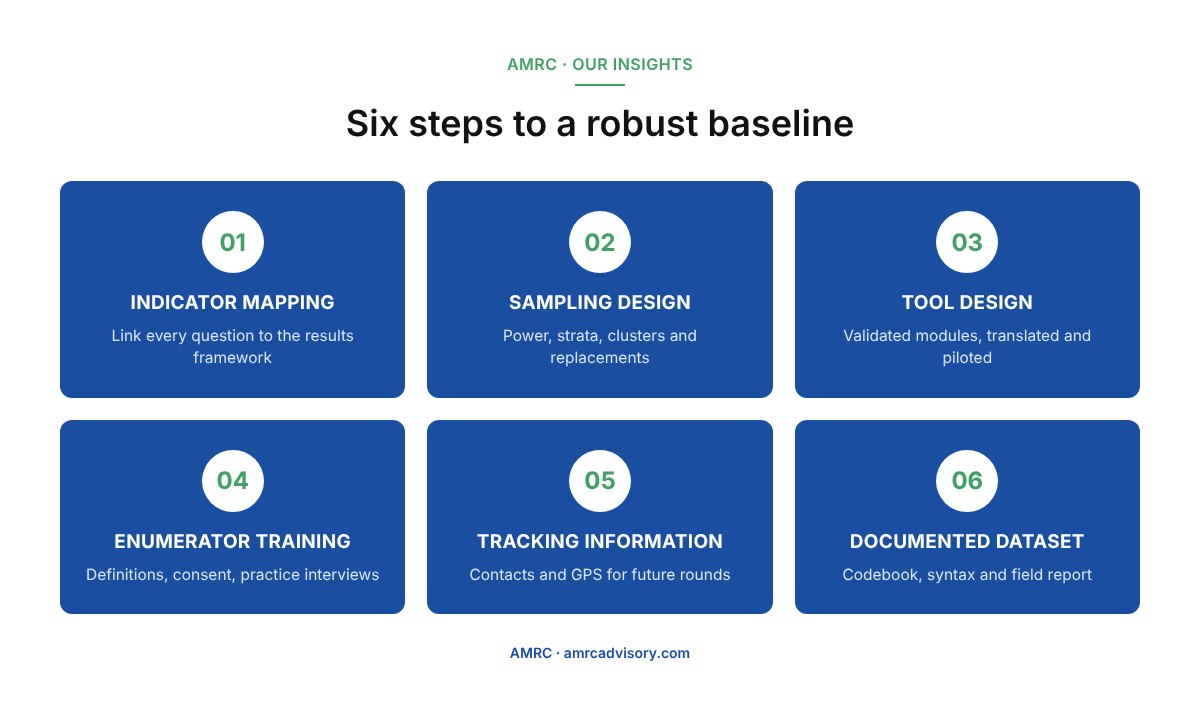
4. Design and test tools for the real context
Using validated modules from recognised survey programmes is good practice, but they still need adaptation. Translation and back-translation, cognitive testing and a field pilot help ensure that respondents understand questions in the way intended. The pilot is also the moment to measure interview length: an overly long questionnaire lowers data quality in its final sections.
- Keep each module tied to an indicator, and place sensitive questions after rapport is built.
- Program skip logic, ranges and consistency checks directly in the CAPI form.
- Prepare local units and examples for quantities, prices and areas.
- Agree on the final version with the client and freeze it before fieldwork.
5. Train enumerators on concepts, not only on questions
Enumerators must understand the definitions behind the indicators: who is a household member, what counts as income, how to record a business that operates part of the year. Training should include practice interviews, informed consent, safeguarding, and a final test. Consistent understanding across teams is what makes data comparable between zones and between rounds.
6. Collect tracking information for panel follow-up
If the same respondents will be interviewed again, the baseline must collect what is needed to find them years later: GPS coordinates, phone numbers of the respondent and of a relative or neighbour, landmarks and a short description of the location, all with explicit consent. This information should be stored separately from the analytical data to protect confidentiality.
A baseline is not a stand-alone survey. It is the first round of a series, and it should be designed as such.
7. Treat data management as a deliverable
The baseline dataset will be reused by other teams, sometimes by another firm at endline. It should therefore be delivered with a codebook, cleaning syntax, a description of the sample and weights, the final questionnaires in every language and a field report documenting replacements and incidents. Unique identifiers must be stable so that records can be linked across rounds.
Data protection deserves the same attention. Personal identifiers, contact details and GPS points should be encrypted, access should be limited to named people, and the retention rules agreed with the client and donor should be written down from the start.
Common mistakes to avoid
- Finalising the questionnaire before the indicators are operationally defined.
- Sizing the sample on budget alone, without a power calculation.
- Changing question wording at midline without documenting it.
- Forgetting to collect tracking information for panel respondents.
- Delivering a dataset without codebook, weights or field documentation.
How AMRC can help
AMRC supports development organisations, M&E teams and consulting firms with baseline, midline and endline surveys in North Africa, the Sahel, West Africa and the Middle East. We work as a subcontractor, local partner or white-label team: reviewing tools against the results framework, adapting and translating instruments, training enumerators, running digital data collection with daily quality control, and delivering documented datasets ready for analysis and future rounds.
Key takeaways
- Define every indicator operationally before writing the questionnaire.
- Size the sample with power calculations and plan for attrition.
- Keep questions, reference periods and timing identical across rounds.
- Collect tracking information with consent if respondents will be revisited.
- Deliver a documented dataset with codebook, weights and field report.
Frequently asked questions
What is the difference between a baseline and a needs assessment?
A needs assessment helps design a programme by identifying problems and priorities. A baseline measures the starting value of the indicators the programme will track, so that change can be assessed at midline and endline.
How large should a baseline sample be?
It depends on the indicators, the expected change, the number of groups to compare and the expected attrition. As an indication, programme baselines often range from a few hundred to a few thousand respondents, but the right size should come from a power calculation.
Should the baseline be done before the programme starts?
Ideally yes, before beneficiaries receive any activity. When this is not possible, the timing should be documented and taken into account in the analysis.
Can a different firm conduct the endline?
Yes, and it happens often. This is why the baseline must be delivered with full documentation: questionnaires, codebook, sampling details, identifiers and tracking information, stored securely.
Preparing a baseline survey?
Share your terms of reference and we will propose a sampling approach, field plan and budget estimate.
