

What each approach delivers, where it stops, and how to combine them in a market study for Africa and the Middle East
Companies entering a new market, investors screening an opportunity and consulting firms preparing a recommendation all face the same early question: can we answer this from existing sources, or do we need to go to the field? The answer shapes the timeline, the budget and the confidence of the final decision.
In Africa and the Middle East, the question is especially relevant. Published information can be abundant on some topics and almost absent on others, and conditions on the ground often move faster than reports. This article explains what desk research and field research each deliver, where they stop, and why the strongest market studies usually combine them.
What desk research gives you
Desk research, or secondary research, means collecting and analysing information that already exists: official statistics, sector reports, regulatory texts, trade data, company publications, press coverage, academic work and online sources. It is the fastest way to build a structured picture of a market.
- An overview of market structure, segments and main players.
- The regulatory and administrative framework for market entry.
- Macro trends, demographic data and indicative orders of magnitude.
- A first view of price levels, distribution channels and competition.
- A clear list of what is not known and must be verified.
Where desk research stops
Secondary sources have limits that are easy to underestimate. Data may be several years old, collected with definitions that do not match your question, or available only at national level when you need a city or a segment. Informal trade, which is significant in many African markets, is often poorly captured. And reports rarely explain why buyers choose one product over another, or how distributors actually decide what to stock.
Desk research is also only as good as its source checking. Figures repeated across many websites may come from a single unverified estimate.
What field research gives you
Field research, or primary research, means collecting new information directly from the people and places that matter: consumers, distributors, retailers, industry experts, public officials, competitors’ clients. It can be qualitative, quantitative or observational.
Common field methods in a market study
- In-depth interviews with importers, distributors, buyers and sector experts.
- Store checks and retail audits to observe prices, brands and shelf presence.
- Consumer surveys, face to face, by phone or online depending on the target.
- Focus groups to understand perceptions, motivations and barriers.
- Mystery shopping and observation of the customer journey.
Field research answers the questions that matter most for a decision: who buys, why, at what price, through which channel, and what would make them switch.
Where field research stops
Field research takes longer to organise, requires local teams and costs more per insight. A handful of interviews cannot size a market on their own, and a survey without a clear framing may collect a lot of data that answers the wrong question. Field research is most effective when it is targeted, and that targeting usually comes from desk work.
Timelines and budget logic
As a rough indication, a focused desk study can often be delivered in one to three weeks, depending on scope and the number of countries. A field phase typically adds several weeks for tool design, recruitment, interviews or data collection, and analysis. Budget follows the same logic: desk research is driven by analyst time, while field research is driven by the number of interviews, locations, languages and the difficulty of reaching respondents.
The useful question is not which approach is cheaper, but what level of certainty the decision requires.
How to combine them in a market study
The most efficient sequence is simple: use desk research to frame hypotheses, then use field research to validate, correct or reject them.
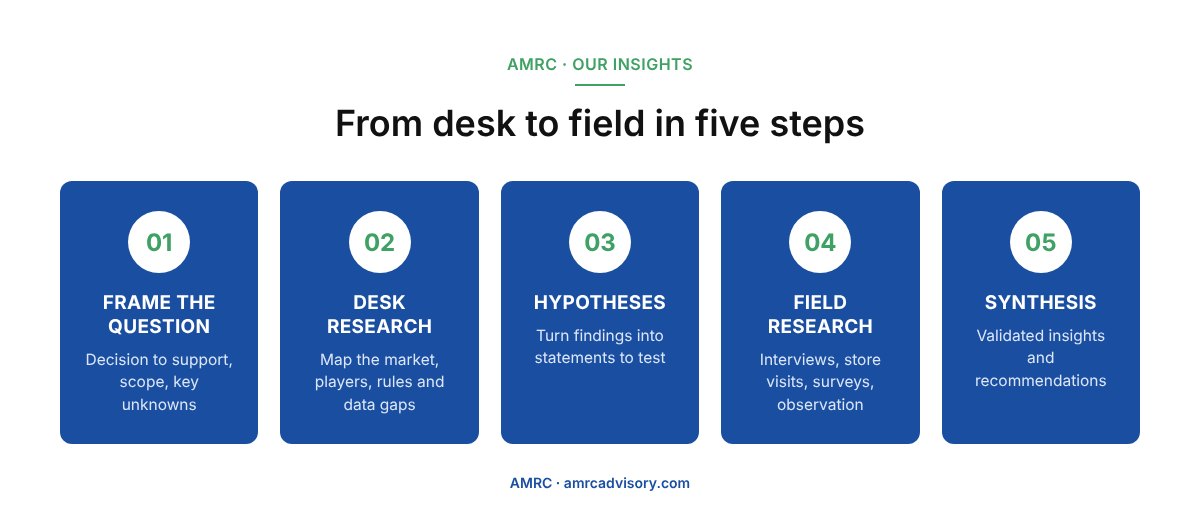
Consider a few typical situations. A food manufacturer looking at a North African market can use desk research to map imports, regulations and leading brands, then run store checks and distributor interviews to understand real shelf prices and margins. A service company assessing a Gulf market can start from published sector data, then interview potential corporate clients to test willingness to pay. A firm looking at West African or Sahel markets may find that secondary data is thin, and that early expert interviews are needed to fill gaps before any survey is designed.
The sequence is not always strictly linear. Field findings often send the team back to secondary sources, for example to check a new competitor or a regulation mentioned by a distributor. This back-and-forth, sometimes called triangulation, is what turns separate data points into conclusions a decision-maker can rely on.
Desk research tells you what is already known. Field research tells you what is actually happening. A good market study needs both, in the right order.
Common mistakes to avoid
- Making a market entry decision on desk data alone, without checking it on the ground.
- Launching fieldwork without first reviewing what is already known.
- Treating a single unverified figure as a reliable market size.
- Asking the field team to answer questions that are too broad to test.
- Ignoring informal channels because they do not appear in published data.
How AMRC can help
AMRC designs and delivers market studies and market entry research in North Africa, the Sahel, West Africa and the Middle East, combining desk research with field research in English, French and Arabic. We work directly for companies and as a subcontractor, local partner or white-label team for research and consulting firms: from desk reviews and hypothesis framing to expert interviews, store checks, consumer surveys and final synthesis.
Key takeaways
- Desk research is fast and structured, but often dated, incomplete or too general.
- Field research explains real behaviour, prices and channels, but needs clear targeting.
- Use desk research to frame hypotheses and field research to test them.
- Cross-check field findings against secondary sources before concluding.
- Choose the mix according to the level of certainty your decision requires.
Frequently asked questions
Can desk research alone be enough?
Yes, for an early screening, a first comparison between countries or a briefing before a meeting. For a market entry decision, a pricing strategy or a partner choice, it should usually be completed by field checks.
How many interviews are needed in a field phase?
It depends on the market and the questions. As an indication, a qualitative phase often covers a few dozen expert and trade interviews, while a quantitative survey needs a sample sized for the segments you want to compare.
What if there is very little published data on a market?
Then early expert interviews become part of the desk phase. Talking to importers, distributors or sector associations quickly fills gaps and helps design the rest of the study.
Can desk and field research run in parallel?
Partly. Recruitment and logistics for fieldwork can start while desk research is being completed, but the field tools should be finalised only once the main hypotheses are clear.
Planning a market study?
Tell us about your target market and decision, and we will propose the right mix of desk and field research.
