
Recruitment, group composition, moderators, venues, consent and analysis: the practical choices that decide whether qualitative fieldwork produces real insight
Surveys tell you how many people do something. Focus groups and in-depth interviews tell you why. For consumer brands, consulting firms and development programmes working in Morocco, Algeria, Tunisia, Mauritania, Senegal, Mali, Niger, Burkina Faso or Chad, qualitative research is often the fastest way to understand motivations, barriers and the vocabulary people actually use.
But qualitative fieldwork is less forgiving than it looks. A poorly recruited group, a moderator who does not share the participants’ language or an unsuitable venue can turn two hours of discussion into polite, unusable answers. Here is what experienced teams get right.
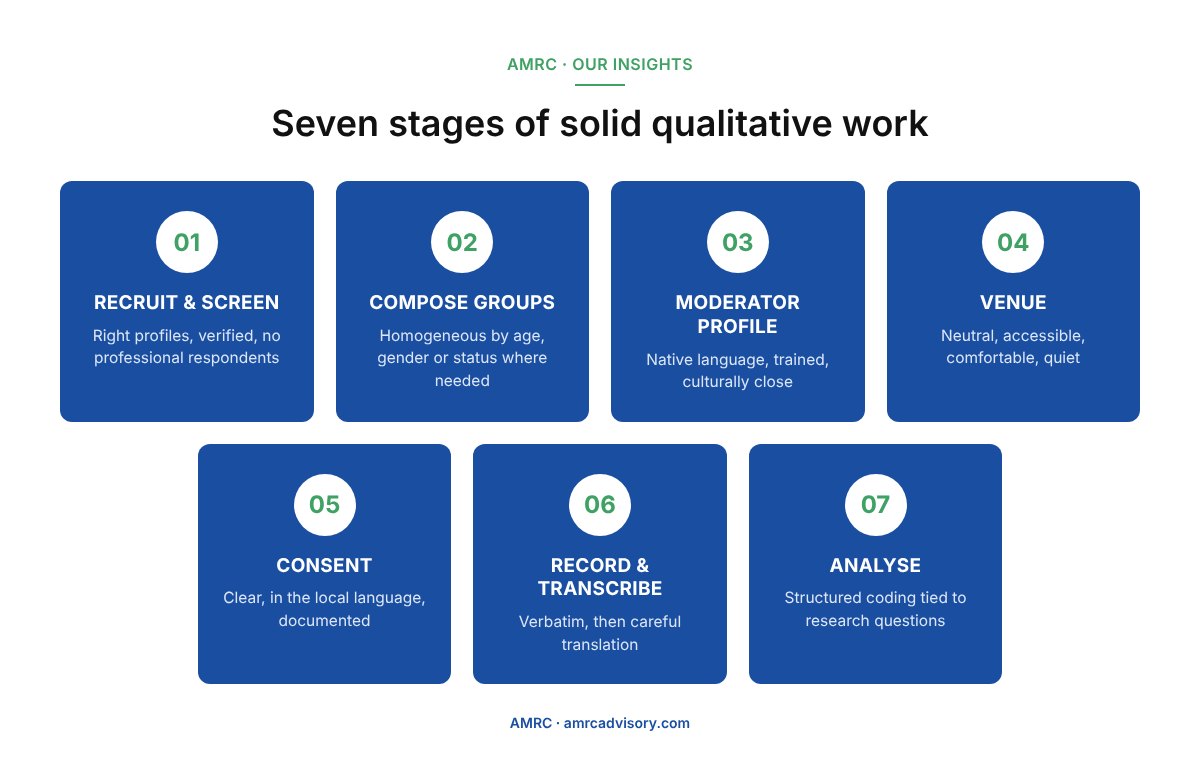
1. Recruitment and screening come first
The value of a focus group depends on who is in the room. Recruitment should follow a written screener that checks the criteria agreed with the client: age, gender, location, occupation, product usage or programme participation.
- Recruit through several channels: field recruiters, community contacts, customer lists provided by the client, local associations.
- Exclude professional respondents and people who took part in a similar study recently.
- Avoid recruiting friends or relatives into the same group.
- Re-screen participants on arrival to confirm they match the profile.
- Over-recruit slightly to cover no-shows, especially in rural areas.
For in-depth interviews with experts, officials or business owners, recruitment is closer to stakeholder outreach: introduction letters, follow-up calls and flexibility on time and place.
2. Compose groups that let people speak freely
Participants talk more openly when they feel among peers. In many communities across North Africa and the Sahel, this means separating groups by gender and, often, by age or social status. Young women, for example, may express themselves very differently when older relatives or men are present.
Gender separation is not automatic. In some urban, professional or student settings, mixed groups work well and can even enrich the discussion. The decision should be made case by case, based on the topic, the target and local advice from the field team.
3. Language and moderator profile
The moderator is the main research instrument. Ideally, he or she speaks the participants’ first language natively: Darija, Amazigh languages, Hassaniya, Wolof, Bambara, Fulfulde, Hausa, Chadian Arabic or others, in addition to French or English for reporting.
- Match the moderator’s gender to the group when groups are gender-separated.
- Choose a moderator close enough to participants to build trust, but neutral on the topic.
- Brief the moderator in depth on the objectives, not only on the guide.
- Run a debrief after each session to adjust probes for the next one.
4. Choose the right venue
Viewing facilities with one-way mirrors exist in some large cities, but most qualitative work in the region takes place in hotel meeting rooms, rented spaces, community centres or, in rural areas, a quiet room offered by a local association. What matters is that the venue is neutral, easy to reach, comfortable and quiet enough for a clean recording. Avoid places linked to the client, a programme office or local authorities, which can influence what people say.
5. Manage group dynamics and social desirability
In any group, some voices dominate and others stay silent. In contexts where politeness and respect for elders matter, participants may also give the answer they think is expected rather than what they really think.
Practical techniques
- Start with easy, concrete questions about daily life before the core topic.
- Use projective techniques, stories and card sorting to lower pressure.
- Ask about “people like you” rather than the participant directly on sensitive points.
- Give quieter participants a direct, gentle invitation to speak.
- Follow up sensitive topics in individual interviews rather than in the group.
In qualitative research, the quality of insight is decided before the first question is asked: by who is recruited, who moderates and where people sit.
6. Consent, recording and transcription
Informed consent should be explained orally in the local language, then recorded in writing or on audio. Participants need to know who is conducting the study, how recordings will be used, that they can stop at any time and how their identity will be protected. Incentives, when offered, should be modest and given regardless of what participants say.
Sessions are usually audio-recorded and, where appropriate and agreed, video-recorded. Transcription should be verbatim in the original language first, then translated into French or English by translators who know the local expressions. Keeping key quotes in both versions helps the client hear the authentic voice of participants.
7. From transcripts to analysis
Analysis should start from the research questions, not from the transcripts. A coding frame built from the discussion guide, refined after the first sessions, allows the team to compare segments and locations systematically. Tools such as NVivo, MAXQDA or structured spreadsheets help, but the value comes from analysts who were close to the field and can interpret nuance.
Common mistakes to avoid
- Recruiting through a single contact, which fills groups with people who know each other.
- Using a moderator who works through an interpreter in the main session.
- Running mixed groups by default on sensitive topics.
- Holding sessions in the client’s or a programme’s premises.
- Delivering only translated summaries, without verbatim transcripts.
- Waiting until the end of fieldwork to read any transcript.
How AMRC can help
AMRC runs qualitative fieldwork across North Africa, the Sahel and the Middle East as a subcontractor, local partner or white-label team for research companies, consulting firms and development organisations. We handle recruitment and screening, native-language moderators, venues, consent, recording, transcription and translation in English, French and Arabic, and can support analysis and reporting.
Key takeaways
- Use a written screener and re-screen participants on arrival.
- Separate groups by gender, age or status when the topic and context require it.
- Choose native-language moderators who are trusted but neutral.
- Pick neutral venues and explain consent in the local language.
- Deliver verbatim transcripts and code them against the research questions.
Frequently asked questions
How many participants should a focus group include?
As an indication, six to eight participants usually works well. Smaller groups of four to six, sometimes called mini-groups, are useful for sensitive topics or specialised profiles such as business owners or health workers.
When should I choose in-depth interviews instead of focus groups?
In-depth interviews are better for sensitive or personal topics, for senior or hard-to-gather profiles, and when you need to understand individual decision journeys in detail. Focus groups are better for exploring shared norms, reactions to concepts and the language people use.
Can focus groups be run online in the region?
Online groups can work for connected urban targets such as students, young professionals or SME managers. For rural, older or less connected populations, face-to-face sessions remain more reliable.
How long does a qualitative project take?
It depends on the number of sessions and locations. As a rough guide, recruitment and preparation take one to two weeks, fieldwork one to three weeks, and transcription, translation and analysis two to three weeks.
Planning qualitative research in North Africa or the Sahel?
Share your objectives and target groups, and we will propose a recruitment plan, moderator team and timeline.
