
Why on-the-ground verification of partners, markets and stakeholders is often the most valuable part of a pre-investment or pre-partnership review
Companies, investors and development organisations looking at francophone Africa, from Morocco and Senegal to Mali, Côte d’Ivoire, Niger or Chad, usually start their due diligence with desk research. Company registries, published reports, media monitoring and online databases are quick and inexpensive.
The problem is that in many of these markets, the information that really changes a decision is not online. Registries can be incomplete or outdated, many reputable businesses have a limited digital footprint, and the most important relationships are rarely documented. This article looks at what desk research tends to miss, and how field verification fills the gap.
The limits of desk research
- Incomplete records: business registries do not always reflect current shareholders, managers or activity.
- Limited publication: many private companies do not publish accounts, and sector statistics may be several years old.
- Language and source gaps: relevant information often exists only in French or Arabic, in local press or in informal channels.
- Online image versus reality: a polished website can hide a modest operation, while a solid company may have almost no online presence.
Desk research remains essential. It frames the questions and identifies red flags. But on its own, it rarely gives enough confidence to sign a partnership, a distribution agreement or an investment.
What field verification adds
1. Is the business real and active?
A site visit, discreet observation and conversations with neighbours, suppliers or customers quickly show whether premises, staff, equipment and activity match what the company presents.
2. What is its reputation in the market?
Interviews with trade contacts, industry associations, competitors and former partners reveal how a company and its managers are perceived: reliability in payments, quality of service, relationships with authorities and any past disputes.
3. Who really decides?
Formal organisation charts do not always reflect who holds influence. Stakeholder mapping identifies the key decision-makers, the networks around the company and potential conflicts of interest.
4. Does the market match the business plan?
Field checks on prices, distribution, competition and customer demand test the assumptions behind a business plan. A quick store check, interviews with distributors or a short customer survey can confirm or challenge projected volumes.
5. What is the operating environment like?
Logistics, access to inputs, availability of skilled staff, and practical administrative procedures all affect execution. People on the ground can describe these realities far more precisely than general country reports.
Staff and management due diligence
When an investment or partnership depends on a few key people, background checks on management and key staff are equally important: verification of professional history and qualifications, references from former employers or partners, and a clear picture of their standing in the business community. These checks must always be conducted discreetly, legally and with respect for privacy.
How to organise effective field due diligence
- Start with desk research to set the hypotheses and red flags to test.
- Define clear questions for the field team rather than a general mandate.
- Use local researchers who speak the languages and understand business codes.
- Cross-check every important finding with at least two independent sources.
- Deliver a concise report with a clear risk rating and recommendations.
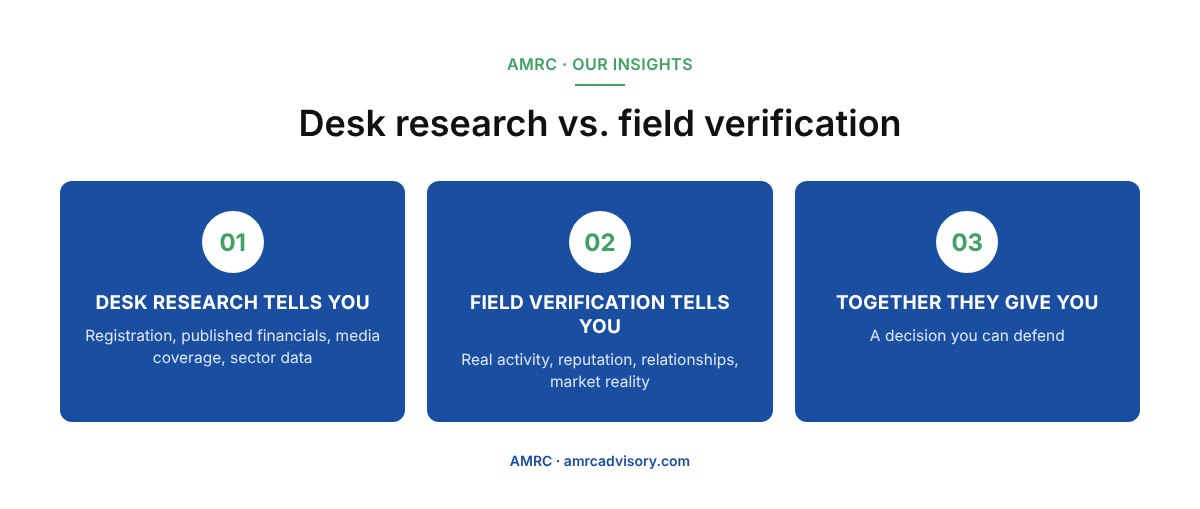
Desk research tells you what is written. Field verification tells you what is true on the ground.
Common mistakes to avoid
- Relying only on documents provided by the counterpart.
- Commissioning field checks too late, after terms have been negotiated.
- Using researchers from outside the country who lack local networks and language skills.
- Collecting information without a clear legal and ethical framework.
- Producing long reports without a clear conclusion on risks and next steps.
How AMRC can help
AMRC supports CEOs, investors and organisations with business due diligence and decision-making support in North Africa, the Sahel and other francophone African markets: partner and distributor screening, market reality checks, stakeholder mapping, staff due diligence and introductions to relevant decision-makers. We combine desk research with discreet field verification by local teams, in French, Arabic and English.
Key takeaways
- Desk research frames the questions but often misses what changes a decision.
- Field verification confirms real activity, reputation and decision-makers.
- Market checks on the ground test the assumptions of a business plan.
- Background checks on key people should be discreet, legal and respectful of privacy.
- Cross-check findings with independent sources and deliver a clear risk rating.
Frequently asked questions
How long does field due diligence take?
A focused review of one company or partner usually takes two to four weeks, depending on the number of questions, locations and interviews required.
Is field due diligence legal and discreet?
Yes, when conducted properly. It relies on public information, observation and voluntary interviews, follows local laws and data protection rules, and avoids any misrepresentation.
Which countries can be covered?
AMRC covers North Africa, the Sahel (Mauritania, Senegal, Mali, Burkina Faso, Niger, Chad) and other French-speaking African countries through local teams and trusted networks.
What do I receive at the end?
A concise report with findings for each question, sources and level of confidence, a risk rating and practical recommendations for the decision or the negotiation.
Assessing a partner or an opportunity in francophone Africa?
Tell us what you need to verify, and we will propose a discreet, focused due diligence scope.
