
Claims, packaging, product, sensory and customer journey: five tests that reduce launch risk in one of the world’s most diverse consumer markets
The United Arab Emirates is often used by international and regional brands as a showcase market for the Gulf. Modern retail, high e-commerce adoption, strong purchasing power and a very international population make it an attractive launch pad.
But the same diversity that makes the UAE exciting also makes it hard to predict. Residents come from dozens of nationalities, with different tastes, languages, shopping habits and expectations. A product that wins in one community can leave another indifferent. Consumer testing before launch is the most cost-effective way to reduce that uncertainty.
Why testing matters more in the UAE
- A multicultural population: Emirati, Arab, South Asian, Southeast Asian, Western and African consumers often shop the same shelves with different expectations.
- Intense competition: shelves are crowded with global, regional and private-label brands, and new products have little time to prove themselves.
- High expectations on quality and presentation, in-store and online.
- Bilingual communication: Arabic and English must both work on pack and in communication, and labelling must comply with local and GCC requirements.
Testing does not replace creativity or marketing intuition. It checks that the choices made will be understood and valued by the people who are supposed to buy the product.
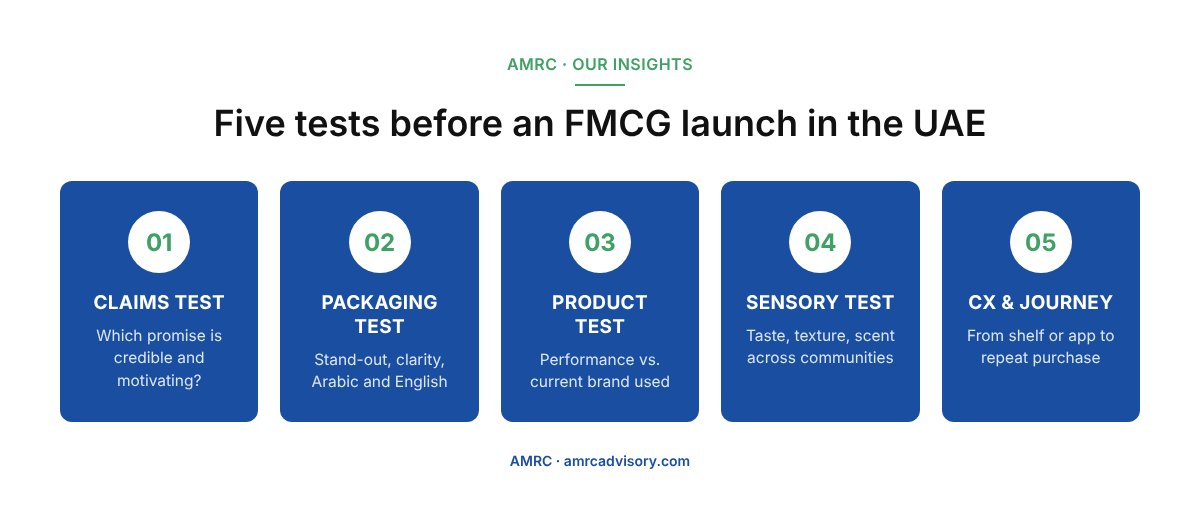
1. Claims testing: which promise convinces?
Before investing in packaging and campaigns, brands need to know which message works best. Claims testing evaluates several promises, such as natural, high protein, long-lasting or dermatologically tested, on credibility, relevance, uniqueness and purchase intent. It also identifies claims that create doubt or confusion, which is especially useful when the same claim is read in two languages.
2. Packaging testing: does it stand out and does it speak clearly?
On a crowded shelf or a small mobile screen, packaging has a few seconds to be noticed and understood. Packaging tests measure stand-out against competitors, clarity of the key message, perceived quality and value, and the reading of bilingual information. Comparing two or three design routes before final production helps avoid expensive redesigns after launch.
3. Product testing: does it deliver?
In-home use tests or central location tests compare your product with the brand consumers currently use. They answer the decisive questions: does it perform as well or better, would people buy it again, and at what price? In the UAE, it is useful to read results by key nationality groups and by income level, not only on the total sample.
4. Sensory testing: taste, texture and scent
For food, beverages, personal care and household products, sensory preferences vary widely between communities. A level of sweetness, spice or fragrance intensity that is ideal for one group may be too strong or too weak for another. Sensory tests with trained or consumer panels help fine-tune the formula or decide which variants to launch first.
5. Customer experience and journey testing
The launch does not end on the shelf. Mystery shopping, e-commerce journey tests and post-purchase surveys show how the product is presented in store, how easy it is to find and order online, how delivery goes and what drives repeat purchase. These tests are particularly relevant for brands that rely on quick-commerce apps and online marketplaces.
Making testing fast and affordable
Consumer testing does not have to delay a launch. Online panels, quick central location tests in malls and short in-home use tests can deliver actionable results within a few weeks. The key is to focus each test on a clear decision: which claim, which pack, which formula, which price.
In a market as diverse as the UAE, the most expensive test is the one you skip before launch.
Common mistakes to avoid
- Testing only with one nationality group and assuming results apply to the whole market.
- Testing the pack design but not the claims printed on it.
- Running tests too late, when production and media are already committed.
- Looking only at average scores instead of the share of strong rejection.
- Ignoring the online shelf, where many first purchases now happen.
How AMRC can help
AMRC designs and runs consumer tests for FMCG brands in the UAE and the wider region: claims, packaging, product, sensory and customer experience testing, with quantitative and qualitative methods. We recruit the right consumer profiles across nationalities and deliver clear, decision-oriented recommendations.
Key takeaways
- The UAE’s diversity makes launches harder to predict and testing more valuable.
- Test claims and packaging before investing in production and media.
- Compare product performance with the brands consumers already use.
- Read results by nationality groups, not only on the total sample.
- Check the full customer journey, in store and online.
Frequently asked questions
How many consumers are needed for a product or packaging test?
Quantitative tests typically use samples of 100 to 200 respondents per tested variant or per key target group. Qualitative tests such as focus groups or in-depth interviews use smaller samples to explore reactions in depth.
Should tests be run in Arabic or English?
Both, depending on the target. Questionnaires and stimuli should be available in Arabic and English, and sometimes in other languages for specific communities.
Online or in person?
Online tests are fast and cost-effective for claims and packaging. Product and sensory tests usually need in-home use or central location tests where consumers can try the product.
Can results from the UAE be used for other GCC markets?
The UAE gives useful early signals, but consumer profiles differ across GCC countries. For major launches, a lighter validation in Saudi Arabia or other target markets is recommended.
Preparing a product launch in the UAE?
Tell us what you need to decide, and we will propose the right test, sample and timeline.
