
Subcontracting, local partnership or white-label delivery: how the right field partner protects data quality, timelines and budgets
Research agencies, strategy consultancies and development organisations are increasingly asked to deliver studies across several countries in Africa and the Middle East. Clients want comparable data from Casablanca, Dakar, Bamako, N’Djamena and Dubai, often within tight timelines.
Very few firms have permanent teams in all these markets. The question is therefore not whether to rely on external resources, but how to choose and work with the right local field partner. Here is why it matters, and what to look for.
The hidden costs of going it alone
Flying in a team from headquarters or managing freelancers remotely can look cheaper on paper. In practice, it often creates hidden costs:
- Longer timelines to recruit, train and supervise enumerators you have never worked with.
- Weaker data quality when interviewers do not speak the local language or know the field.
- Difficult access to respondents, from senior executives to rural households.
- Administrative complexity: permissions, contracts, payments and logistics in unfamiliar environments.
- Reputational risk if the project is delayed or the data cannot be defended.
What a good local field partner brings
Ready-to-deploy teams
An established partner already has a network of trained enumerators, supervisors and moderators, with the right language skills and gender mix. This can shorten the mobilisation phase significantly.
Local knowledge
Knowing how to recruit respondents for a focus group in Casablanca, how to reach SMEs in Bamako or which period to avoid for household surveys in Chad is the kind of knowledge that only comes from years of field experience.
Quality control you can audit
A professional partner works with digital data collection, GPS and time stamps, back-checks and daily reporting. You keep full visibility on progress and quality, without being on the ground.
Cultural and linguistic adaptation
Translation, back-translation and cognitive pre-testing ensure that questions mean the same thing in every country. This is essential for multi-country comparability.
Three models of collaboration
Depending on the project and on your relationship with the end client, the partnership can take different forms.
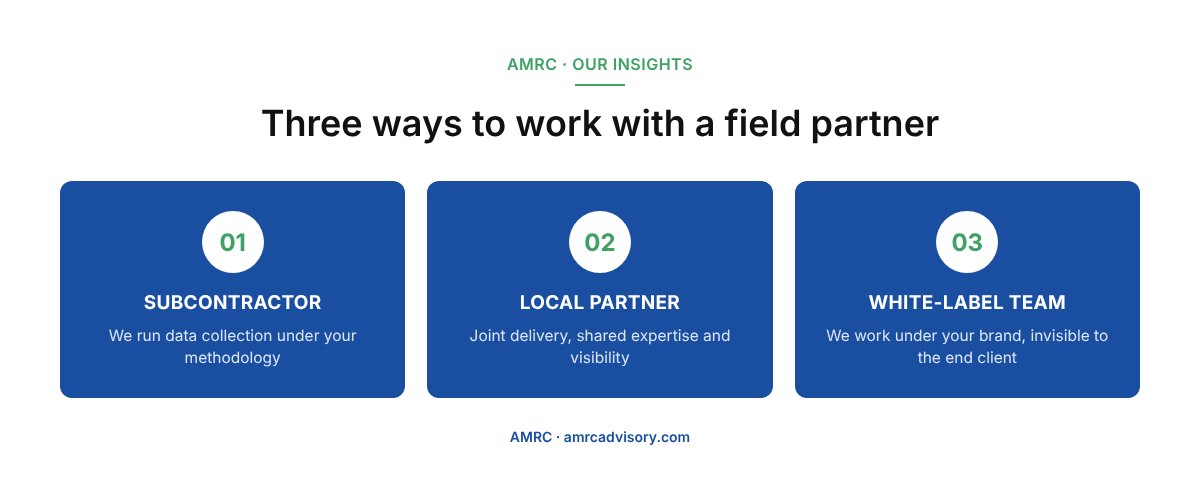
- Subcontractor: you design the methodology and own the analysis; the partner handles data collection and delivers clean datasets.
- Local partner: the partner contributes local expertise, field operations and sometimes part of the analysis, with shared visibility.
- White-label team: the partner works fully under your brand, following your processes and templates. The end client deals only with you.
How to choose the right partner
Before signing, it is worth checking a few points:
- Track record in the countries and sectors concerned, with references.
- Field team size, languages covered and supervision ratios.
- Quality-control protocols and the tools used for digital collection.
- Data protection practices and compliance with your client’s requirements.
- Ability to work in English and French, and to follow your templates.
- Responsiveness: a clear single point of contact and fast turnaround on proposals.
The best field partner is the one your end client never has to worry about.
What a smooth collaboration looks like
In practice, a well-run partnership follows a simple rhythm. The client shares the terms of reference and draft tools. The partner reviews them with a local eye, proposes adjustments, a sampling and field plan and a budget. Once the project starts, both teams agree on a kick-off, a validated translation, a pilot report, daily progress dashboards and weekly calls. At the end, the partner delivers clean data, a codebook, transcripts where relevant and a field report documenting what happened on the ground.
This transparency is what allows the client to present the results to its own end client with confidence, whether the partner is visible or works in white label.
Common mistakes to avoid
- Choosing a partner on price alone, without checking supervision ratios and quality-control protocols.
- Sending final tools without leaving time for local review, translation and piloting.
- Not agreeing in advance on replacement rules, data formats and delivery deadlines.
- Multiplying partners across countries without a common quality framework.
How AMRC works with research and consulting firms
AMRC is a research and field partner in Africa and the Middle East. With offices in Dubai, Morocco and Chad, we run fieldwork and deliver research as a subcontractor, local partner or white-label team for research companies, consulting firms and development organisations. Our services cover full-service studies, quantitative and qualitative data collection, recruitment of respondents and project support, in English, French and Arabic.
Key takeaways
- Managing fieldwork remotely without a local team carries hidden costs.
- A local partner brings ready teams, field knowledge and auditable quality control.
- Choose between subcontracting, local partnership or white-label delivery.
- Check track record, languages, QC protocols and data protection before signing.
Frequently asked questions
What is white-label research?
In a white-label arrangement, the field partner works under your brand: enumerators introduce the study on your behalf or on behalf of your end client, deliverables use your templates and the end client deals only with you.
Who owns the data?
Data ownership is defined in the contract. In most subcontracting and white-label arrangements, the data belongs to the client or the end client, and the field partner applies the confidentiality and data protection rules agreed.
Can a local partner work on multi-country studies?
Yes. A partner with offices or networks in several countries can coordinate multi-country fieldwork with harmonised tools, training and quality control, which improves comparability between countries.
How quickly can fieldwork start?
With an established partner, fieldwork can often start within a few weeks of approval, once tools are translated and tested and teams are trained.
Looking for a field partner in Africa or the Middle East?
Send us your terms of reference or RFP and we will reply with a field plan and quote.
