
Morocco is one of the most attractive gateways between Europe, Africa and the Middle East. Here is how to test the opportunity before committing capital.
Morocco has become a natural destination for companies looking to expand beyond Europe or the Gulf. Its location close to Europe, its network of free trade agreements, its modern port and industrial infrastructure and its role as a hub towards West Africa make it an obvious candidate on many expansion shortlists.
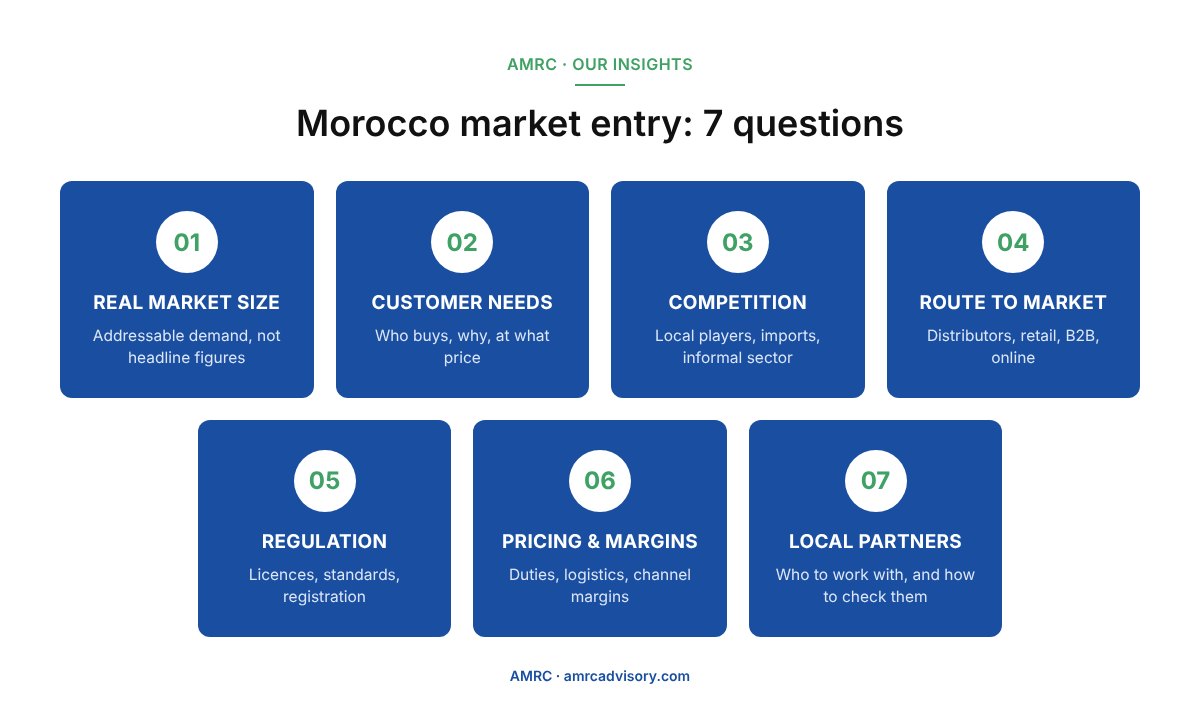
Yet attractiveness at country level does not guarantee success for a specific product or service. Over fifteen years of market entry and desk research work for foreign companies, we have seen the same pattern: the firms that succeed are those that answer a short list of practical questions before they invest. Here are the seven that matter most.
1. How big is the market you can actually reach?
Headline figures such as population, GDP or total imports are a starting point, not an answer. What matters is the addressable market: the customers who need your product, can afford it and can be reached through existing channels. In Morocco, purchasing power, consumption habits and access to modern retail vary significantly between large cities such as Casablanca, Rabat, Tangier or Marrakech and the rest of the country.
A solid market sizing combines official statistics, trade data, industry interviews and, where needed, a short consumer or customer survey to validate the assumptions.
2. Who are your customers, and what do they really need?
Products that perform well in Europe or the Gulf sometimes need adjustments in Morocco: pack sizes, price points, language on the label, after-sales service or payment terms. In B2B markets, decision processes and purchasing cycles may also differ from what your teams are used to.
- Which customer segments show the strongest need?
- What do they use today, and why would they switch?
- Which criteria drive the purchase: price, quality, brand, availability, service?
3. Who are you competing with?
Competition in Morocco comes from several directions at once: established local manufacturers, international brands already present, imports from Europe, Turkey or Asia, and in some categories an active informal sector. Mapping these players, their prices and their distribution strength gives a realistic view of the space left for a new entrant.
4. How will your product reach the customer?
Route to market is often the deciding factor. Depending on the sector, success may depend on a strong importer or distributor, listings in modern retail chains, coverage of traditional neighbourhood shops, public tenders, or direct B2B sales. E-commerce is growing but still needs to be combined with physical channels in most categories.
Understanding who controls each channel, what margins they expect and how they choose their suppliers should be part of any entry study.
5. What are the regulatory requirements?
Depending on the product, entry may require registration, certification or compliance with Moroccan standards. Food products, cosmetics, pharmaceuticals, medical devices, construction materials and electrical equipment each have their own procedures and authorities. Setting up a local entity also involves company registration, tax and, in some cases, sector licences.
Institutions such as the Moroccan Investment and Export Development Agency (AMDIE) and the Regional Investment Centres can guide investors, but a clear regulatory checklist at the start avoids costly delays later.
6. Will your price and margins hold up?
A product that is competitive at the factory gate can become expensive once transport, customs duties (depending on origin and applicable agreements), VAT, distributor and retailer margins are added. Building a full price waterfall early on shows whether the target retail price is realistic and whether local assembly or production could change the equation.
7. Who should you partner with, and can you trust them?
Most successful entries rely on at least one local partner: a distributor, an agent, a joint-venture partner or a service provider. Choosing the right one is critical. Beyond the commercial offer, it is worth checking reputation, financial health, existing portfolio, conflicts of interest and real coverage of the market before signing.
From questions to a go or no-go decision
Answering these seven questions does not require a large budget. A focused study combining desk research, expert and trade interviews and, where relevant, targeted fieldwork can usually be delivered in a few weeks. The result is a clear recommendation: go, adapt, or wait, together with the entry model best suited to your company.
Country attractiveness opens the door. Market evidence tells you whether your product should walk through it.
Common mistakes to avoid
- Extrapolating from national averages instead of focusing on the cities and segments you can serve.
- Assuming that a product’s success in Europe or the Gulf will transfer automatically.
- Signing an exclusive distribution agreement for the whole country before testing the partner.
- Discovering registration or certification requirements after the first shipment.
- Setting the retail price without a full calculation of duties, logistics and channel margins.
How AMRC can help
AMRC has supported companies entering Morocco since 2011 with market studies, desk research, competitor and distribution mapping, regulatory checklists and partner screening. Our teams in Casablanca and Dubai combine local market knowledge with international standards, so you can make your decision with confidence.
Key takeaways
- Size the addressable market, not just the country.
- Validate customer needs and adapt the offer where needed.
- Map local, imported and informal competition.
- Secure a realistic route to market and understand channel margins.
- Check regulatory requirements, price structure and partners before signing.
Frequently asked questions
How long does a Morocco market entry study take?
A focused study based on desk research and expert interviews usually takes three to six weeks. If consumer or customer fieldwork is needed, allow a few additional weeks depending on the sample and method.
Do I need a local company to sell in Morocco?
Not always. Many foreign companies start by exporting through a local importer or distributor, then set up a subsidiary or local production once volumes justify it. The right model depends on the sector, the regulatory requirements and your commercial ambitions.
Which cities should I start with?
Most companies start with the Casablanca and Rabat area, then extend to Tangier, Marrakech, Fès, Agadir and other cities depending on their target customers and distribution partners.
Can Morocco serve as a base for West Africa?
Many companies use Morocco as a regional platform thanks to its logistics, financial and business connections with West Africa. Whether this works for your product should be assessed as part of the entry strategy.
Considering Morocco for your next expansion?
Share your product and objectives, and we will propose a focused market entry study.
