
From enumerator recruitment to back-checks, what it takes to collect data you can trust in Mali, Niger, Burkina Faso, Chad, Senegal and Mauritania
International organisations, development programmes and companies increasingly need data from the Sahel: baseline and endline surveys, market assessments, consumer studies, stakeholder interviews. Yet many research teams still treat the region as a place where reliable fieldwork is either impossible or prohibitively expensive.
Neither is true. Good data can be collected in Mali, Niger, Burkina Faso, Chad, Senegal and Mauritania, provided the operation is designed for the realities on the ground rather than copied from a standard survey manual. This guide summarises what experienced field teams do differently.
1. Start with access, not with the questionnaire
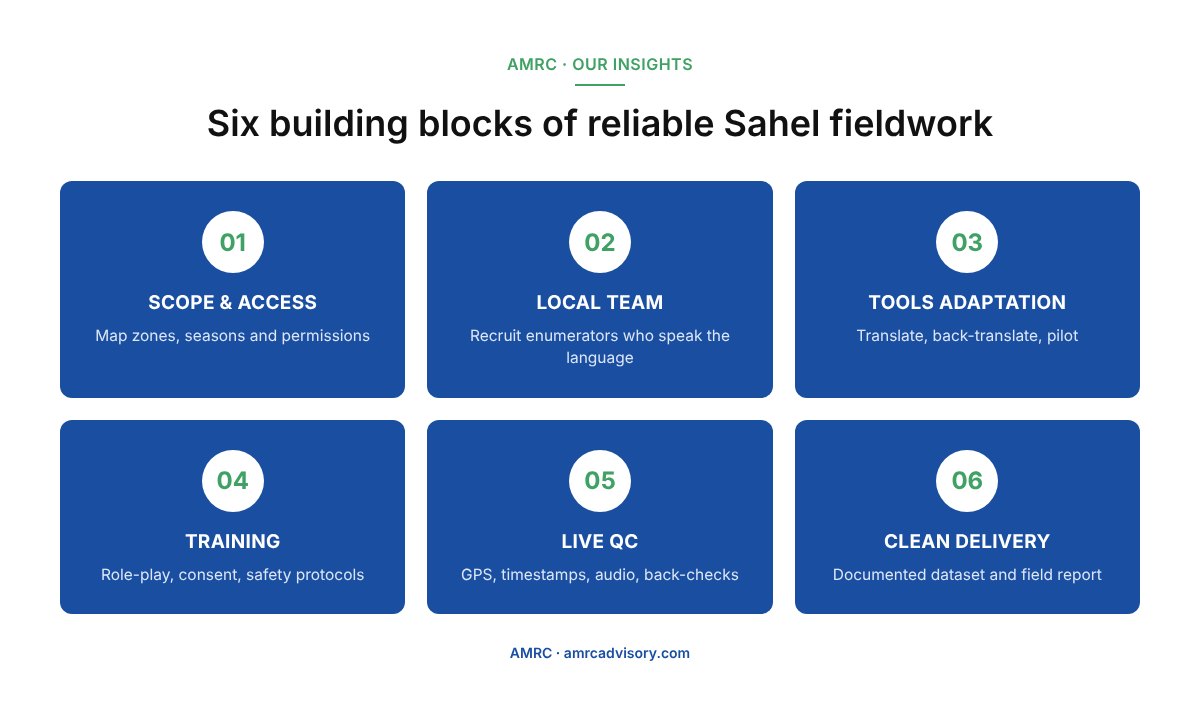
In many projects, the questionnaire is finalised first and the field plan follows. In the Sahel, the order should be reversed. Before fixing the sample, the team needs a clear picture of which areas can be reached, during which period and under what conditions.
- Seasonality: the rainy season can cut off rural roads for weeks, and agricultural calendars shape when households are available.
- Administrative permissions: local authorities, traditional leaders and sometimes sector ministries expect to be informed, and their support opens doors.
- Security conditions: access can change quickly. Plans need alternative zones and replacement rules agreed in advance with the client.
- Distances and logistics: travel time between clusters often drives the budget more than the number of interviews.
A short access assessment at the inception stage saves time later and avoids a sample that looks perfect on paper but cannot be reached in practice.
2. Build a local team that the community trusts
The quality of a survey depends on the people who knock on doors. In the Sahel, this means recruiting enumerators and supervisors who come from, or know well, the areas they will cover. They speak the local languages, understand social codes and are accepted by communities.
Language coverage deserves particular attention. French or Arabic may be official languages, but interviews often take place in Bambara, Fulfulde, Hausa, Songhay, Moore, Wolof, Hassaniya, Chadian Arabic or other languages depending on the zone. Mixed-gender teams are also essential whenever women respondents are part of the sample, which is the case in most development studies.
3. Adapt the tools before you deploy them
A questionnaire designed in an office in Paris, Washington or Dubai rarely works unchanged in a village near Mopti or Abéché. Concepts such as household, income or employment do not always translate directly, and some questions can be sensitive.
- Translate key instruments and run a back-translation on sensitive modules.
- Pilot the questionnaire in real conditions and measure interview length.
- Simplify answer options and add local examples where respondents hesitate.
- Agree on the final version with the client before full deployment.
4. Train for real situations, not just for the questionnaire
Enumerator training should go beyond reading the questions aloud. Effective sessions combine role-play, practice interviews, informed consent procedures, safeguarding and do-no-harm principles, and clear instructions on what to do when the situation on the ground changes. A short written test at the end helps select the strongest profiles.
5. Use digital collection, and design for low connectivity
Computer-assisted personal interviewing (CAPI) on tablets or smartphones, using tools such as SurveyCTO, KoboToolbox or ODK, has transformed fieldwork in the region. It reduces entry errors, enforces skip logic and makes daily monitoring possible.
The key is to plan for intermittent connectivity: forms must work offline, devices need power banks or solar chargers, and supervisors must have a routine for syncing data whenever a network is available.
6. Make quality control continuous and visible
Quality control is what separates a dataset you can defend from one you cannot. The best practice is to monitor data every day, not at the end of fieldwork.
- Automated checks on interview duration, GPS location and timestamps.
- Random audio audits, with respondent consent, on a share of interviews.
- Back-checks by phone or in person on a sample of respondents.
- Daily dashboards shared with the client so issues are fixed while teams are still in the field.
7. Put duty of care at the centre
Field teams in the Sahel sometimes work in difficult environments. A responsible operation includes a security protocol, check-in procedures, clear rules on movement, insurance, and the right to stop an interview or leave an area without penalty. Protecting respondents matters just as much: confidentiality, data protection and referral pathways when sensitive issues come up.
What this means for international clients
For a research firm, a consulting company or a development organisation working from abroad, the most efficient model is usually to work with a local field partner that already has trained teams, local language coverage and quality-control routines in place. The partner handles the operational complexity while the client keeps control over the methodology and the analysis.
Reliable data in the Sahel is not a matter of luck. It is the result of careful access planning, the right local teams and quality control from day one.
Common mistakes to avoid
- Copying a sample design from another country without checking access and travel times.
- Underestimating the time needed for translation, piloting and permissions.
- Recruiting enumerators only in the capital and sending them to areas they do not know.
- Checking data quality only at the end of fieldwork, when it is too late to re-interview.
- Treating security and safeguarding as a paragraph in the proposal rather than an operational plan.
How AMRC can help
AMRC runs fieldwork and data collection across North Africa, the Sahel and West Africa, as a subcontractor, local partner or white-label team for research companies, consulting firms and development organisations. We manage recruitment, training, digital data collection and daily quality control, and deliver clean, documented datasets.
Key takeaways
- Plan access, seasons and permissions before fixing the sample.
- Recruit local enumerators with the right languages and mixed-gender teams.
- Translate, back-translate and pilot every instrument.
- Use offline-ready digital collection and monitor quality every day.
- Make duty of care for teams and respondents non-negotiable.
Frequently asked questions
How long does a household survey take in the Sahel?
It depends on the sample size, the number of zones and the season. As an indication, a survey of a few hundred to a few thousand interviews usually requires two to four weeks of preparation (tools, translation, recruitment, training, pilot) and two to six weeks of data collection, followed by cleaning and reporting.
Can phone surveys replace face-to-face interviews?
Phone surveys are useful for follow-ups, monitoring and some urban populations. However, mobile coverage and phone ownership vary, especially among rural women and older respondents, so face-to-face interviews remain the reference for representative household surveys in most Sahel contexts.
Which languages should be covered?
The answer depends on the zones. A field partner should map languages per area during inception and make sure each team includes enumerators who speak the main local languages, in addition to French or Arabic.
How can a client monitor quality remotely?
Through daily dashboards built from the digital collection platform, showing progress, interview durations, GPS points, flagged cases and back-check results. Regular calls with the field coordinator complete the picture.
Planning a study in the Sahel?
Tell us about your project and we will share a field plan, timeline and budget estimate.
